|
 |
 |
 |
 |
 |
 |
 |
 |

 |
The Human Dimesions Of A Near-Earth Object Impact
New Brunswick - Feb 17, 2003 Recently Lee Clarke, a sociology professor at Rutgers, The State University of New Jersey, discussed "Responding to Panic in a Global Impact Catastrophe" during a symposium at the American Association for the Advancement of Science (AAAS) annual meeting in Denver. The session, "The Asteroid/Comet Impact Hazard: A Decade of Growing Awareness," took place Thursday morning (Feb. 14) at the Colorado Convention Center. Clarke is an internationally known expert in disasters and in organizational and technological failures. He has written about panic, civil defense, evacuation and community response to disaster, and is the author of "Mission Improbable: Using Fantasy Documents to Tame Disaster," a book about planning for very low probability-high consequence events. Despite the mass panic depicted in the movies and on television, Clarke said this is not what happens in real disasters. "We have five decades of research on all kinds of disasters -- earthquakes, tornadoes, airplane crashes, etc.-- and people rarely lose control," he said. "Policy-makers have yet to accept this. People are quite capable of following plans, even in the face of extreme calamities, but such plans must be there." For a disaster plan to be successful, Clarke said that communication must play an integral role. He pointed out that officials may lose the public's trust and doom the plan to failure if information is withheld based on the false assumption that people will become hysterical. Clarke issued the caveat that for plans to be effective, a nation must have a sufficiently developed infrastructure for carrying out a civil defense program during a major disaster. Clarke noted that no one has actually planned for the massive disaster that could accompany collision with a near-earth object (NEO) -- a comet or an asteroid. "While the idea of this happening is almost unthinkable, we must realize that no countries have plans in place nor are there international agreements for coordinated civil defense responses," he said. "The United States is the world leader in most things, and we ought to be out in front in talking about the danger and in expending resources on deflection and mitigation," he continued. Though science policy advisers from the 30 member nations of the Organisation for Economic Cooperation and Development are considering NEO contingency proposals, Third World countries are not represented. Clarke stressed that the problem needs to be highlighted in the United Nations, where the voices and interests of poorer countries can be heard. Clarke posed the example of an NEO striking the ocean, a likely scenario since 70 percent of the earth's surface is ocean. "An asteroid hitting the water could create an immense wave hitting the coasts," Clarke said. "An appropriate civil defense plan could focus on moving the population inland prior to impact." He said that even now we should be talking publicly about population relocation, potentially on a massive scale, and developing incentives for geographical redevelopment to slow the rate of people moving into vulnerable places. "Earth's history is filled with unanticipated catastrophes and their disastrous consequences. With appropriate planning, the human toll could be lessened," said Clarke. Community Email This Article Comment On This Article Related Links Rutgers, the State University of New Jersey SpaceDaily Search SpaceDaily Subscribe To SpaceDaily Express Asteroid and Comet Impact Danger To Earth - News and Science
 NASA's Deep Impact Adds Color To Unfolding Comet Picture
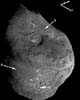 College Park MD (SPX) Sep 07, 2005
Painting by the numbers is a good description of how scientists create pictures of everything from atoms in our bodies to asteroids and comets in our solar system. Researchers involved in NASA's Deep Impact mission have been doing this kind of work since the mission's July 4th collision with comet Tempel 1. |
|
|

| The content herein, unless otherwise known to be public domain, are Copyright 1995-2006 - SpaceDaily.AFP and UPI Wire Stories are copyright Agence France-Presse and United Press International. ESA PortalReports are copyright European Space Agency. All NASA sourced material is public domain. Additionalcopyrights may apply in whole or part to other bona fide parties. Advertising does not imply endorsement,agreement or approval of any opinions, statements or information provided by SpaceDaily on any Web page published or hosted by SpaceDaily. Privacy Statement |