|
 |
 |
 |
 |
 |
 |
 |
 |

 |
The Hidden Biospheres Of Planet Earth
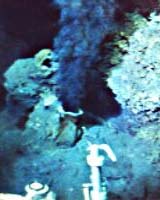
Moffett Field CA (SPX) Nov 14, 2006 Two recent discoveries in astrobiology challenge many of our assumptions about an integrated biological community on Earth. At the microbial level, it seems that there may be previously hidden biospheres that exist on Earth alongside our more familiar neighbors. One such community has been found deeply buried underground, while the other lives in the sea alongside more familiar life forms. Potentially among the most important recent discoveries in astrobiology is the finding of deeply buried life forms that appear to thrive independent of the familiar surface biosphere, which is powered by sunlight. These microbes, discovered in hot groundwater 2.8 km deep in a South African gold mine, ultimately draw their energy from chemical compounds hydrogen and sulfates -- produced by the slow decay of radioactive elements in the rocks. The existence of a deep subsurface microbial community on Earth suggests that similar isolated biospheres could persist on other planets, such as Mars, in spite of hostile conditions on their surfaces. A large international research team, led by scientists from Princeton and Indiana Universities and supported in part by the NASA Astrobiology Institute, announced their discovery in a paper published in the 20 October 2006 issue of Science. The first author of the paper is Li-Hing Lin, now of National Taiwan University, who started this work as a Princeton graduate student. The scientists took advantage of a water-filled fracture that was intersected during drilling in a deep gold mine near Johannesburg. They began to collect water samples within a few days of initial flow in order to ensure minimum contamination, and continued to draw new samples over several months. Using modern genetic analysis tools, the team was able to compare the microbes with other anaerobic microbial communities that derive their energy from sulfate reduction. A detailed study of the water chemistry indicates that there is sufficient naturally occurring sulfate and hydrogen to sustain life indefinitely. The base of the food chain is a sulfate reducer belonging to the phylum called Firmicutes, and other microbes in the community may subsist on products from this primary producer. The water itself was dated at tens of millions of years, during which time it has had no physical or chemical contact with the familiar world far above. In recent years, scientists have discovered many communities of microbes living under conditions formerly thought impossible for life. These extremophiles can thrive under conditions of high and low temperature, acid or alkaline chemistry, or high salinity that would kill more familiar surface microbes. Some of these extremophiles live in communities at hydrothermal vents in the deep ocean or within the rock, hundreds of meters below the surface. Until now, however, the deep biosphere appeared to require at least some indirect contact with the atmosphere. This discovery, from a much deeper and more isolated environment, represents a major breakthrough, revealing an alien form of life within the Earth. This discovery may yield key insights for the habitability of Mars and other planets with hostile surfaces but warm water in their interiors. NASA missions have revealed that Mars once had a surface environment more suitable for life, with liquid water and sunlight, circumstances under which life may have formed and thrived billions of years ago. Perhaps the remnant of that life persists below the surface, in environments like this sunless sea on Earth. The second exciting discovery is of a previously unknown rare biosphere that co-exists with more familiar life forms in the deep ocean. The discoverers are a team of scientists from the Marine Biological Laboratory at Woods Hole and the Royal Netherlands Institute for Sea Research, under the leadership of Mitch Sogin, who is also the PI for the MBL team in the NAI. These scientists used new genetic analysis tools to look past the dominant microbial populations to sample the much rarer microbes that have previously gone undetected, using samples collected from both normal cold sea water and the hot water associated with hydrothermal vents. Their work was published in the Proceedings of the National Academy of Sciences for 8 August 2006. This new analysis reveals enormous diversity within this rare biosphere. The techniques used do not permit individual organisms to be isolated for study, but they allow statistical estimates of the population. Although the numbers of such microbes are small, there is at least 100 times greater species diversity than had been expected. What are all these diverse organisms doing? In a sense, they are not very successful, since they are far outnumbered by more familiar species. Yet they persist in small numbers. Perhaps they represent a kind of natural back-up system or reserve force that can swing into action if environmental conditions change in ways that threaten the dominant ecosystem. They could be part of lifes strategy to survive even catastrophic environmental changes. The next challenge is to estimate the global patterns in this rare biosphere and to begin to characterize its individual species. Community Email This Article Comment On This Article Related Links NASA Astrobiology Institute Beyond Sol Darwin Today At TerraDaily.com Life Beyond Earth Lands Beyond Beyond - extra solar planets - news and science
 James Van Allen And Astrobiology
 Moffett Field CA (SPX) Nov 14, 2006
A little before midnight, on January 31, 1958, a countdown reached zero and a rocket hesitated on its launch pad at Cape Canaveral. Around the Cape, birds soared screeching into the night sky, suddenly awoken by the deafening engine and its dazzling flame. The rocket ascended with its unique payload, scientific instruments of a kind never flown in space. On the ground the scientists and engineers watched as the exhaust flame rose overhead, 60 miles above the Earth. Explorer 1 had reached the edge of space and in a few minutes would release the first artificial satellite to carry a scientific package. |
|
|

| The content herein, unless otherwise known to be public domain, are Copyright 1995-2006 - SpaceDaily.AFP and UPI Wire Stories are copyright Agence France-Presse and United Press International. ESA PortalReports are copyright European Space Agency. All NASA sourced material is public domain. Additionalcopyrights may apply in whole or part to other bona fide parties. Advertising does not imply endorsement,agreement or approval of any opinions, statements or information provided by SpaceDaily on any Web page published or hosted by SpaceDaily. Privacy Statement |