|
 |
 |
 |
 |
 |
 |
 |
 |

 |
The Galactic Centre Region
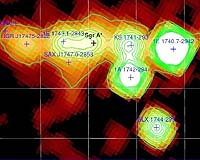
Paris, France (SPX) Sep 15, 2005 In an article to be published in the Astrophysical Journal, Belanger et al. present the results of a detailed analysis of approximately 1900 hours of observations of the galactic centre, obtained with Integral since the launch of the spacecraft in October 2002. The IBIS/ISGRI imager on the Integral observatory detected for the first time a hard X-ray source, IGRJ17456�2901, located within 1 arcminute of Sagittarius A* (Sgr A* - the black hole residing at the centre of our Galaxy) over the energy range 20�100 keV. Two years and an effective exposure of 4.7�106 s have allowed for obtaining more stringent positional constraints on this high-energy source and the construction of its spectrum in the energy range 20�400 keV. This central source near Sgr A* appears not te be a point source as previously thought, but likely is a diffuse, but compact, source. The observations by Belanger et al. also show that the source is faint, but persistent with no detected variability. The galactic centre as observed with IBIS/ISGRI onboard INTEGRAL. The image covers a region of about 2.5� x 1.5�. Credits: G. Belanger (CEA Saclay) et al. By combining the ISGRI spectrum together with the total X-ray spectrum corresponding to the same physical region around Sgr A* from XMM-Newton data, and collected during part of the gamma-ray observations, Belanger et al. have also constructed the first accurate wide band high-energy spectrum for the central arcminutes of the Galaxy. These findings are also presented in the upcoming publication (see also 'Belanger et al. 2005'). Community Email This Article Comment On This Article Related Links SpaceDaily Search SpaceDaily Subscribe To SpaceDaily Express Stellar Chemistry, The Universe And All Within It
 Sloan Survey Identifies New Dwarf Galaxy Inside Milky Way
 Washington DC (SPX) Jan 10, 2006
Astronomers using the Sloan Digital Sky Survey have discovered a previously unknown cluster of stars within the Milky Way that appears to be a separate dwarf galaxy being consumed by its much larger neighbor. |
|
|

| The content herein, unless otherwise known to be public domain, are Copyright 1995-2006 - SpaceDaily.AFP and UPI Wire Stories are copyright Agence France-Presse and United Press International. ESA PortalReports are copyright European Space Agency. All NASA sourced material is public domain. Additionalcopyrights may apply in whole or part to other bona fide parties. Advertising does not imply endorsement,agreement or approval of any opinions, statements or information provided by SpaceDaily on any Web page published or hosted by SpaceDaily. Privacy Statement |