|
 |
 |
 |
 |
 |
 |
 |
 |

 |
The Future For Raul Castro And Hugo Chavez
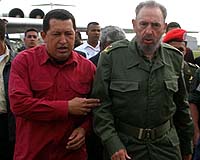
UPI Commentator Washington (UPI) Oct 09, 2006 A lot of people don't like Hugo Chavez, the elected revolutionary leader of oil-rich Venezuela. At the top of the list, of course, is President George W. Bush, whom Chavez recently described as "the devil" in a speech to the U.N. General Assembly. Others include many voters in other Latin American nations, including Peru and Mexico, who resent Chavez's efforts to influence elections in their countries. But someone else who might have reason not to like him is Raul Castro --Fidel's younger brother and defense minister who became acting president of Cuba this past summer until Fidel recovers from his illness (if he ever does). Now this might seem like a strange claim to make. Both Castros are as anti-American as Chavez is. And Chavez has been subsidizing the Cuban economy through supplying it with oil at below-market prices. On the few occasions that Raul Castro has been seen in public in recent weeks, he has usually been in the company of Hugo Chavez during the latter's visits to Cuba either to comfort the ailing Fidel or attend the recent Non-Aligned Movement summit in Havana. Not only, then, does Raul have reason to be grateful to Chavez, but his behavior toward his Venezuelan comrade strongly suggests that he actually is. But put yourself in Raul's position. He's played second fiddle to his older brother all his life. While undoubtedly loyal to him, it is highly likely that Raul has long planned to step into his big brother's shoes if Fidel could no longer rule. Raul almost certainly does not want anyone else to do so. Further, he has a reputation for being both suspicious and ruthless. What, then, must he think of Chavez? Cheap Venezuelan oil has played an important role in replacing the loss of Soviet aid after the Soviet Union broke up and in mitigating the negative effects of the American economic embargo. But surely Raul must wonder what Chavez expects to get in exchange for this assistance. Even Chavez's loud and lavish praise for Fidel must seem suspicious to Raul, for Chavez has made it clear that he sees himself as Fidel's heir as the foremost revolutionary leader of Latin America. Maybe Raul hoped to inherit this role himself. But even if not, he might well be uneasy about how Chavez intends to play it. Chavez wants to put together an alliance of anti-American governments, including Cuba. He can certainly do much to worsen Cuba's already poor relations with the United States, but he can't do anything to protect Cuba from it if Cuban-American ties deteriorate. Does Chavez expect that Cuba after Fidel will simply follow his lead in his ongoing confrontation with the United States? Would Chavez threaten to cut back or cut off the subsidized oil he supplies Havana if Raul doesn't want to follow his lead? I don't know the answer to either of these questions. And I doubt that Raul does either. Admittedly, I have not seen any hard evidence indicating that Raul has reservations about Chavez. On the other hand, Raul has been busy since he became acting president in increasing economic contacts with other nations. Russian-Cuban relations became and remained poor between the time Vladimir Putin met with Fidel in Havana in 2000 and Raul became acting president this past summer, but since then, Russian Prime Minister Mikhail Fradkov met with Raul and extended Cuba a $355 million loan. Chinese, Canadian, Indian, Argentinean, Spanish, and of course, Venezuelan business interests in Cuba have also increased. As an article appearing on the website of the Russian newspaper Kommersant recently put it, "Cuba's solvency seems to improve as Fidel Castro's health is worsening." A worst case analyst would see increased Russian and Venezuelan aid to Cuba as evidence of a growing alliance among all three countries. However, the fact that Russian-Cuban relations, which were so poor while Fidel was in charge, have suddenly improved now that Raul is in power belies this. Moreover, that Raul seems to have been the prime mover behind Fidel's earlier grudging concessions to market economics while Chavez is increasingly moving away from this indicates that Raul and Chavez have real differences over economic policy. Raul's willingness to accept aid and investment from several countries, then, suggests that, unlike Fidel, he is not content to rely primarily on Venezuela. There is no guarantee that Raul and Chavez will fall out. But the desire of each man to claim Fidel's mantle, as well as their differing interests and policy preferences, suggest that they just might. American foreign policymakers cannot make this happen, but they need to recognize the possibility that a rift between Raul and Chavez could occur in order to avoid policies that would discourage it. -- (Mark N. Katz is a professor of government and politics at George Mason University.)
Source: United Press International Community Email This Article Comment On This Article Related Links Learn about the Superpowers of the 21st Century at SpaceWar.com Democracy in the 21st century at TerraDaily.com
 Brazilian Readies For Lift-Off After Russian Winter Training
 Star City, Russia (AFP) Mar 15, 2006
Brazilian astronaut Marcos Pontes said Tuesday he had to overcome extreme cold in Russia during training but was ready for his journey into space later this month. "Now that my training is almost over, I feel happiness because I am going to space after so long but also sadness because my friends will stay here," Pontes said at a press conference in Star City. |
|
|

| The content herein, unless otherwise known to be public domain, are Copyright 1995-2006 - SpaceDaily.AFP and UPI Wire Stories are copyright Agence France-Presse and United Press International. ESA PortalReports are copyright European Space Agency. All NASA sourced material is public domain. Additionalcopyrights may apply in whole or part to other bona fide parties. Advertising does not imply endorsement,agreement or approval of any opinions, statements or information provided by SpaceDaily on any Web page published or hosted by SpaceDaily. Privacy Statement |