|
 |
 |
 |
 |
 |
 |
 |
 |

 |
The Eros of Cratering and Explosions
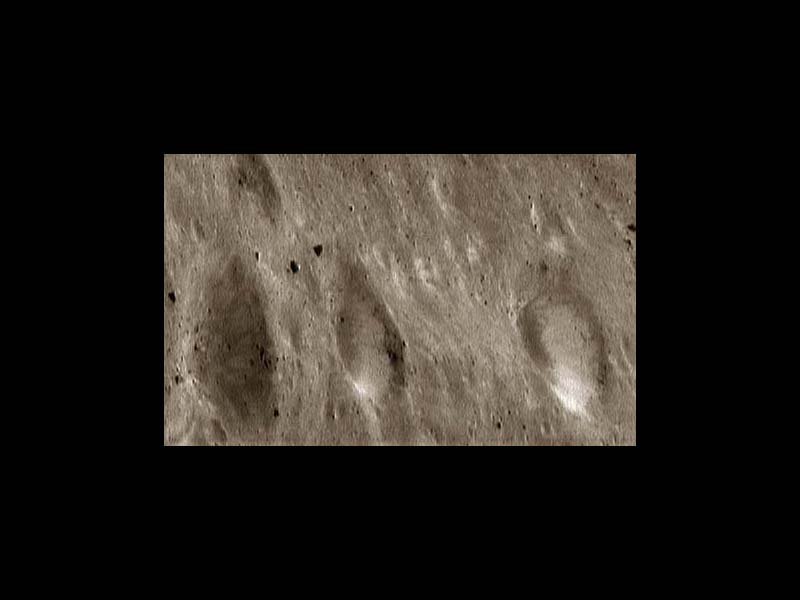
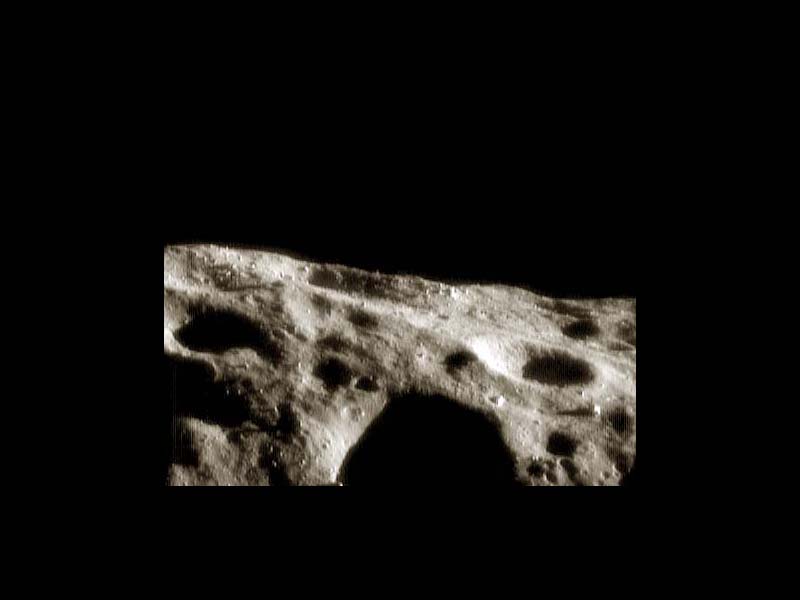
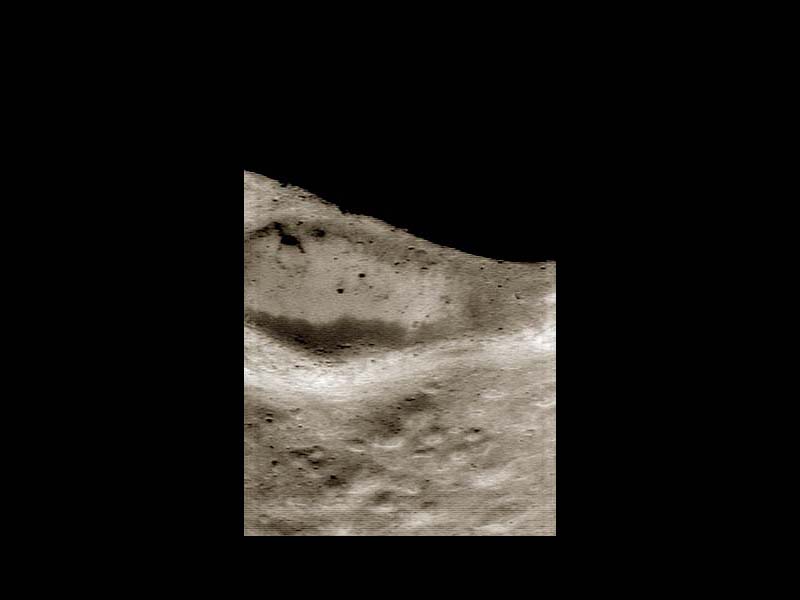
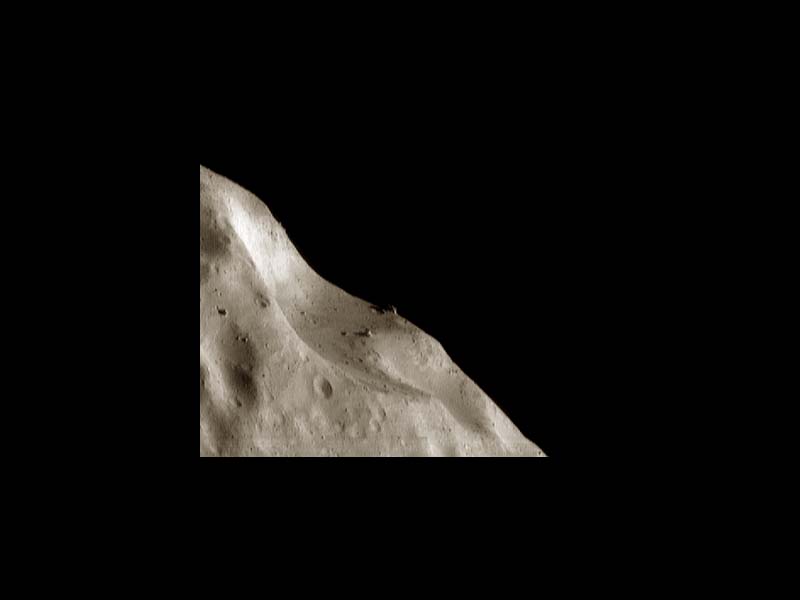
Laurel - August 25, 2000 - Laurel - August 25, 2000 - The craters on Eros are among its most spectacular and beautiful features. I am not sure why, but I find something about rugged terrain to be exciting, and I suspect it's hard-wired in the human brain. For some reason, when artists wish to inspire us, they paint intrepid explorers or ancient hermits at the edge of a great cliff, or on a mountain top, or peering over clouds into a magnificent valley - but whether the artists are 19th century Americans or 11th century Chinese, they do not picture the subjects standing in the midst of vast flat plains extending to the horizon. When I talk to people who live in flat country or who visit there, I often hear complaints about the lack of topography, but I never hear of people being inspired by flatness. Fortunately for those of us who like topography, on Eros there is hardly a flat spot to be found. Much of the ruggedness comes from the huge number of craters. We saw last time how the density of craters allows us to infer relative ages of surfaces, but there is much more we can learn. This is because a cratering event excavates far below the surface of an object and thereby exposes its interior, performing a natural experiment that we could not perform on our own. Not only does this give us a chance to see what the interior is made of, we can often infer mechanical properties of the target, using our knowledge of how craters are formed. We think that impacts on asteroids occur at a typical velocity of around 5 km/s. That is in itself a complicated story for another day, because it reflects the distributions of bodies in the asteroid belt, or specifically how many objects of a given size are found in a given orbit. The problem is, the objects that would make the craters we now see on Eros are so small and so far from Earth that we have no way to detect them - not even using the Space Telescope - so we have no direct knowledge of how many such objects there are or where they may be. Nevertheless, if we assume that these objects, that we cannot see, have the same orbital distributions as the much larger objects that we can see, then we can calculate the average speeds at which objects would collide if their orbits happen to intersect. That is where numbers like 5 km/s come from, and we don't really know how good they are. High as these impact speeds are, they are small compared to the speeds at which an asteroid would typically impact Earth (a very small asteroid, we would hope). This is because of Earth's gravity, which pulls any impactor inward and accelerates it to speeds of 15 km/s or more, depending on where the impactor came from (that is, what its initial orbit was). At such high speeds, an impact is more like an explosion than the mere penetration of one object by another. This is what Daniel Barringer did not appreciate when he convinced himself and numerous unlucky investors that fortunes could be made by mining the iron from the meteorite that made Barringer Crater (update of August 7). A hypervelocity impact at a speed of 15 km/s on Earth, or even the slower 5 km/s impacts in the asteroid belt, would be completely outside our everyday experience. Even high powered rifles fire bullets at speeds below 1 km/s, so Barringer would never have been able to see for himself the effects of a hypervelocity impact. What he did not understand was that a projectile moving even at 3 km/s carries as much kinetic energy as the explosive energy in the same mass of TNT. A projectile at 15 km/s carries even more energy, higher by the square of the velocity, or 25 times more than a 3 km/s projectile. When an impact occurs in rock at 15 km/s, the peak pressures reach 500 GPa. The GPa, or gigapascal, may be an unfamiliar unit of pressure, but it corresponds to 9900 times atmospheric pressure, and even a few GPa suffices to crush the strongest steels we know how to make. Hence when the iron meteorite hit the ground to make Barringer Crater, it was completely crushed, and partly melted and vaporized, even though iron meteorites are made of very strong material. Much of the original projectile mass was expelled from the crater. Not only that, but the original size of the meteorite was much smaller than Barringer thought - maybe only 30 meters in diameter if the impact occurred at 20 km/s, even though the crater itself is a kilometer wide. This meteorite (30 meters is too small to be considered an asteroid) carried an energy equal to that of a 10 megaton thermonuclear bomb. Such was the explosive nature of the impact, and if Barringer had understood it, he would not have died a ruined man. However, Barringer might never have become interested in the crater if he had discerned that there was no fortune to made, and that - in my scientist's mind - would have been a tragedy.
|
These images are sourced from TIF files supplied and produced by JHUAPL. Reprocessing by SpaceDaily.com. Built and managed by The Johns Hopkins University Applied Physics Laboratory, Laurel, Maryland, NEAR-Shoemaker was the first spacecraft launched in NASA's Discovery Program of low-cost, small-scale planetary missions.
|
 Memory Foam Mattress Review |
Newsletters :: SpaceDaily :: SpaceWar :: TerraDaily :: Energy Daily XML Feeds :: Space News :: Earth News :: War News :: Solar Energy News |
 Satellite Launch To Boost DTH In India
 Calcutta, India (SPX) Dec 28, 2005
|
|

|
|
|
|
|
|
|
|
|
|
|
|
| The content herein, unless otherwise known to be public domain, are Copyright 1995-2006 - SpaceDaily.AFP and UPI Wire Stories are copyright Agence France-Presse and United Press International. ESA PortalReports are copyright European Space Agency. All NASA sourced material is public domain. Additionalcopyrights may apply in whole or part to other bona fide parties. Advertising does not imply endorsement,agreement or approval of any opinions, statements or information provided by SpaceDaily on any Web page published or hosted by SpaceDaily. Privacy Statement |