|
 |
 |
 |
 |
 |
 |
 |
 |

 |
The Endless Dawn Of The Ion Age
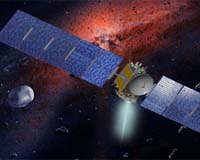
Pasadena CA (JPL) Apr 05, 2008 Dawn is as far from Earth as the Sun. The Dawn mission is continuing very smoothly, with the spacecraft spending almost all of the time since the last log thrusting with its ion propulsion system. As the probe and Earth follow their independent orbits around the Sun, not only has their separation grown, but the relative velocity has as well. So, the rate at which the range from the spacecraft to its erstwhile planetary residence increases has itself increased since the previous report. Today the distance is climbing by nearly 1.6 million kilometers (almost 970 thousand miles), or more than 5 light seconds, per day. Now, 6 months after launch, the separation between Earth and Dawn has widened to be equal to the distance between Earth and the Sun. Most readers, particularly those living elsewhere, recognize that the distance between these latter two solar system bodies, about 150 million kilometers (93 million miles) and known to astronomers as 1 astronomical unit, is arbitrary. Still, using the Earth-Sun distance as a reference may help put the spacecraft's travel into context, and astronomical units are no more arbitrary than kilometers, miles, or the length scales in common use on over 85% of planets subscribing to these logs. That Dawn is as far from Earth as the Sun does not reveal anything, of course, about its direction as viewed from Earth. The Sun and Dawn are 98 degrees apart; Dawn is nearly overhead when the Sun sets. Although the spacecraft is much much too far from Earth to be visible, even with the most powerful telescopes, readers who find enjoyment, if not inspiration for rich thoughts, in celestial sights may consider gazing in the direction of the emissary Earth dispatched to the cosmos. The craft is in Gemini, about 8 degrees east of Mars, an easily located ruby among the gems of the night sky. Your correspondent (reporting on location from Earth) plans to contemplate his view of the Sun during the day and the sky near Dawn in the evening. The spacecraft's reliable performance has allowed the operations team to devote time to more than ensuring the spacecraft stays healthy and on course. In addition to an occasional moment of waxing philosophical about another of humankind's robotic marvels being so remote, the team has been preparing for some special activities during the first part of April. Readers not obeying rules of causality already know the outcome, but the rest may look forward to learning the story in the next log. Dawn is 150 million kilometers (93 million miles) from Earth, or 390 times as far as the moon and as far as the Sun. Radio signals, traveling at the universal limit of the speed of light, take almost 17 minutes to make the round trip. Dr. Marc Rayman Dawn Journal is published by NASA as open source fo the public domain. Community Email This Article Comment On This Article Related Links Space Technology News - Applications and Research
 Russia's Progress Develops New Bion-M Biosatellite
 Samara, Russia (RIA Novosti) Apr 02, 2008
Russia' Progress design and production center is developing a new Bion-M biosatellite for scientific and applied research in space biology and medicine, a spokesman for the center said on Tuesday. He said the new Bion-M being developed by the Samara-based company (European Russia) will be capable of "spending around six months in orbit compared to the current 14 days." |
|
|

| The content herein, unless otherwise known to be public domain, are Copyright 1995-2007 - SpaceDaily.AFP and UPI Wire Stories are copyright Agence France-Presse and United Press International. ESA Portal Reports are copyright European Space Agency. All NASA sourced material is public domain. Additional copyrights may apply in whole or part to other bona fide parties. Advertising does not imply endorsement,agreement or approval of any opinions, statements or information provided by SpaceDaily on any Web page published or hosted by SpaceDaily. Privacy Statement |