|
 |
 |
 |
 |
 |
 |
 |
 |

 |
The End of the Beginning
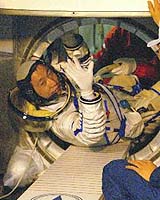
Sydney - Oct 15, 2003 Finally, after years of preparation, China has launched an astronaut. The beginning phase of China's human spaceflight program has now come to an end. But a new chapter in the history of space exploration has just opened. While there will be plenty of scope for analysis of the mission of Shenzhou 5, it's worth stopping to simply consider what a wonderful achievement this is. China has become only the third nation on Earth to develop a crew-carrying spacecraft and launch one of its own citizens into orbit. The significance of this event is magnified by the fact that no nation has joined this elite club for more than 40 years, an incredible interval for technological development. Spaceflight of any sort is a complex and expensive undertaking, but human spaceflight is even more difficult. The scientists and engineers behind the Shenzhou program deserve as much adulation as China's first space traveller. Hopefully, the Chinese government will grant them the credit and the publicity they deserve. The success of the mission should also help to ease open the rather tight curtain of secrecy that has surrounded the Shenzhou program. While we have seen images of the spacecraft and its carrier rocket for several years, solid technical information on Shenzhou has been notoriously scarce. China wants to gain as much kudos as possible from this expensive project, but the government's obsession with controlling information has actually hampered this goal. Coverage of previous Shenzhou missions has been peripheral in non-Chinese media, partially due to a lack of promotional expertise on the part of the Chinese authorities. Journalists and documentary makers who have shown interest in the program, and tried to probe further, have been met with rebuffs from the authorities. Now that the program has matured to this important point, it's time for China to give the world a better look at its spacecraft. How will the world react to this event? In China, there will be justified outpourings of pride in this national achievement. China's media are giving prominent coverage to the flight for understandable reasons, and China's citizenry are probably happy to see a mission they've been expecting as much as the aerospace community. The reaction of the rest of the world is difficult to predict, both in the short and long term. China has made its spaceflight debut at a very turbulent time for both space activity and geopolitical affairs. Shenzhou has entered a stage cluttered with indifference for spaceflight amongst the citizens of most nations with active space programs. The heady days of the nineteen sixties are long past. Space is no longer an unknown frontier. Some in America will probably mock the flight of Shenzhou as tardy: China has only just done something that NASA did more than 40 years ago. But this sort of a response would be as erroneous as it would be insolent. This is no Mercury or Vostok capsule. Shenzhou is a sophisticated, modern spacecraft that is at least as capable as Russia's current Soyuz spacecraft. Although it lacks the sophistication of the US Space Shuttle, it will probably be similar in size and capabilities to whatever NASA eventually develops under the Orbital Space Plane program. But don't expect an increasingly tabloidish mass media to appreciate this. At the other end of the spectrum, hardliners in certain military and political circles will attempt to generate waves of hysteria over a potential Chinese dominance of the space above us. Such arguments will echo the panic that the earliest Soviet space achievements generated in the USA, but the circumstances are much changed. China is unlikely to place atomic weapons aboard Shenzhou or any other satellite. Shenzhou cannot be used as a propaganda trick for generating fears of an enormous missile and space gap with the outside world. The shortfall in intelligence data that allowed the Soviet Union to bluff America in the early sixties does not exist for China, which is scrutinised extensively by the outside world. The geopolitical strength and influence of China has received a boost from Shenzhou, but any gains would be extremely moderate. Shenzhou is not a doomsday device, but it is not entirely benign. China has openly stated that the Shenzhou 5 spacecraft carries a high-resolution camera that essentially makes the vehicle a spy satellite. The Shenzhou program will probably be integrated into China's openly stated plans to exploit space for military purposes. Hawkish officials would do well to take notice of these developments, but avoid the temptation to over-react. Chinese engineers have concocted a variety of curious plans for everything from laser weapons to "parasitic satellites" designed to destroy other spacecraft. But talk is very cheap (especially when compared to spacecraft development budgets), and it remains to be seen if some, or any, of these bold plans will ever reach fruition. The strongest political influence that could be generated from Shenzhou could appear in the near future, if China introduces an equivalent to the Soviet Interkosmos program. Under this program, guest cosmonauts were flown from other nations in the Eastern Bloc, and from other nations considered to be of strategic interest to the Soviet Union. It allowed the Soviets to strengthen their ties to these nations, and also demonstrate their technological might. China is not known to have approached any outside nations for spaceflight opportunities, but once Shenzhou is deemed safe enough for outside passengers, invitations could follow. Foreign astronauts could well be strapped aboard future Shenzhou missions, but they are more likely to be paying passengers than ambassadors of political solidarity. The Soyuz flights of Dennis Tito from the USA and Mark Shuttleworth from South Africa demonstrated that there's a steady market for commercial spaceflight, for tourism or other purposes. China's space industry has been deprived of much commercial revenue through the imposition of US export sanctions on satellites, but there is nothing technologically sensitive about exporting a human for launch. Shenzhou could become the premier recreational vehicle for space. Dr Morris Jones is a postgraduate lecturer at the University of Wollongong, Australia. Email morrisjonesNOSPAMhotmail.com. Replace NOSPAM with @ to send email. Community Email This Article Comment On This Article Related Links SpaceDaily Search SpaceDaily Subscribe To SpaceDaily Express The Chinese Space Program - News, Policy and Technology China News from SinoDaily.com
 Taikonauts On Moon A Far Off Dream For China Yet
 Beijing (XNA) Jan 05, 2006
A one-year lunar fly-by mission may start in April 2007 in China, but a manned flight to the Earth's neighbour may be a long way away, a chief lunar exploration scientist said last night. |
|
|

| The content herein, unless otherwise known to be public domain, are Copyright 1995-2006 - SpaceDaily.AFP and UPI Wire Stories are copyright Agence France-Presse and United Press International. ESA PortalReports are copyright European Space Agency. All NASA sourced material is public domain. Additionalcopyrights may apply in whole or part to other bona fide parties. Advertising does not imply endorsement,agreement or approval of any opinions, statements or information provided by SpaceDaily on any Web page published or hosted by SpaceDaily. Privacy Statement |