
 |
 |
 |
 |
 |
 |
 |
 |
 |

 |
The Drivers Of Tropical Deforestation Are Changing
Washington DC (SPX) Aug 08, 2008 A shift from poverty-driven to industry-driven deforestation threatens the world's tropical forests but offers new opportunities for conservation, according to an article coauthored by William Laurance of the Smithsonian Tropical Research Institute in Panama. "New Strategies for Conserving Tropical Forests" will be featured in the September issue of the leading journal Trends in Ecology and Evolution. Rhett Butler of Mongabay.com, a leading tropical-forest Web site, and Laurance argue that the sharp increase in deforestation by big corporations provides environmental lobby groups with clear, identifiable targets that can be pressured to be more responsive to environmental concerns. "Rather than being dominated by rural farmers, tropical deforestation is increasingly driven by major industries-especially large-scale farming, mining, and logging," said Laurance. "Although this trend is pretty scary, it's also much easier to target a handful of global corporations than many millions of poor farmers." The United Nations estimates that some 13 million hectares (33 million acres) of tropical forest are destroyed each year; but these numbers mask a transition from mostly subsistence-driven to mostly corporate-driven forest destruction, say Butler and Laurance. According to the authors, a global financial market and a worldwide commodity boom are creating conditions ripe for corporate exploitation of the environment. Surging demand for grain, driven by the thirst for biofuels and rising standards of living in developing countries, is also fueling this trend. "Green groups are learning to use public boycotts and embarrassment to target the corporate bad guys," said Butler. "And it works-we're already seeing the global soy, palm oil, and timber industries beginning to change their approach. They're realizing they can't run roughshod over the environment-it's just too risky for them." "In addition, some massive financial firms, including Goldman Sachs, JP Morgan Chase, Citigroup, and Bank of America, have altered their lending practices after coming under fire from environmentalists," said Butler. "Environmental groups are using carrots as well as sticks," said Laurance. "Many multinational corporations are developing greener products because they're more profitable. For example, the market for eco-friendly timber products is expected to be worth tens of billions of dollars in the U.S. by 2010." "We argue that the public and green groups need to send a loud, clear message to the corporate sector," said Laurance. "There's just no profit in destroying the natural world." Community Email This Article Comment On This Article Share This Article With Planet Earth
Related Links Smithsonian Tropical Research Institute Forestry News - Global and Local News, Science and Application
 Greenpeace protest targets Indonesian forestry ministry
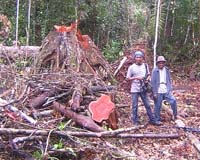
 Jakarta (AFP) Aug 6, 2008
Environmental group Greenpeace hung a banner reading "Stop Deforestation" on the Indonesian forestry ministry Wednesday and called for a moratorium on palm oil concessions on forested land. |
|
|

| The content herein, unless otherwise known to be public domain, are Copyright 1995-2007 - SpaceDaily.AFP and UPI Wire Stories are copyright Agence France-Presse and United Press International. ESA Portal Reports are copyright European Space Agency. All NASA sourced material is public domain. Additional copyrights may apply in whole or part to other bona fide parties. Advertising does not imply endorsement,agreement or approval of any opinions, statements or information provided by SpaceDaily on any Web page published or hosted by SpaceDaily. Privacy Statement |
 del.icio.us
 Digg
Digg Reddit
 YahooMyWeb
 Google
 Facebook