|
 |
 |
 |
 |
 |
 |
 |
 |

 |
The Dirty Side Of Eros
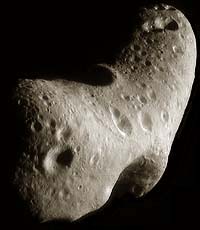
Laurel - July 5, 2000 - What is the regolith of Eros like? Regolith refers to the particulate outer layer of planetary bodies. It is very different for bodies with atmospheres as opposed to airless bodies such as the Moon and asteroids. On Earth, interactions with the atmosphere, with liquid water and with the biosphere all shape the regolith which we know as "soil". Needless to say, these interactions are critical to the survival of life on Earth, but they do not concern us for Eros. Instead, the absence of an atmosphere exposes the regolith on airless bodies to interactions with the space environment. That is, the regolith of Eros is completely unprotected from the energetic photon radiation, the charged particle radiation, and the micrometeoroid fluxes of deep space, whereas the regolith on Earth is shielded by an atmosphere equivalent to 30 feet of water (in terms of the total mass above an area on the ground). Hence, the regolith on airless bodies is unfamiliar to us. Only the regolith of one airless body has been studied in detail - that of the Moon. We have known since 1975, when Eros made a close approach to Earth (within 0.15 AU), that Eros has a regolith. Earth-based telescopic observations in the infrared were able to measure the rate at which Eros's surface cools off at night. These were whole-disk measurements - Eros was too far away to obtain resolved images. When the sun sets, the surface is no longer heated by sunlight, its temperature falls, and it gives less thermal infrared radiation. When the sun rises, the surface warms and gives more infrared radiation. Measurements of thermal infrared emission, roughly in the wavelength range of 10 to 30 microns, can distinguish a surface composed mostly of solid rock from a finely divided, regolith surface, because the former retains heat better - it cools off more slowly at dusk, and it warms more slowly at dawn. We say that such a surface has high thermal inertia. When the infrared measurements were made for Eros, the surface proved to have a low thermal inertia, similar to that of the Moon, and so it was shown that Eros is covered with regolith. The surface of the Moon is shaped largely by impacts of objects large and small. Large impacts of objects as large as asteroids break up and excavate material from deep within the surface and throw it out to great distances, covering preexisting material and leaving behind bowl-shaped craters. Smaller impacts occur more frequently, making a higher density of smaller craters. Microscopic impacts occur most frequently of all. On the microscopic scale, a variety of physical and chemical changes are produced by the continual bombardment of hypervelocity dust grains, ultraviolet and other ionizing photons (e.g., x-rays), and charged particles. Surface grains can be shattered or vaporized; the vapor may condense on adjacent grains; the surface material is eroded by charged particle impacts (a process called sputtering); the ionizing photon and particle radiation create chemically active species that induce complex chains of chemical reactions. Over time, these microscopic processes alter the appearance of the surface of the regolith. Collectively, they are referred to as space weathering, and they are at present imperfectly understood. In the lunar regolith, the space weathering leads to darkening and reddening of the material while reducing spectral contrast (i.e., overall reduction of albedo, change in spectral slope to be less reflective of blue light, and reduction of absorption band depth). All of these processes occur only in the uppermost surface layers, but this surface is what we see. Of course the effect of larger impacts is that material on the surface can be buried by impact ejecta, and at the same time material from far beneath the surface can be excavated and thereby exposed to space weathering. This continual overturning of the regolith is referred to as impact gardening. All of these effects have been studied for the lunar regolith, and we are asking ourselves if they are or should be important for Eros as well. Certainly, Eros has experienced impacts large and small and is exposed to the space environment. However, there are important differences from the lunar regolith. First is the small size of Eros and its correspondingly weak gravity. The escape velocity from Eros ranges from 3 to 17 m/s [7 to 38 mph] over its surface and may be so low that most impact ejecta escape from Eros rather than falling back to the surface. The uncertainty here is not in the escape velocity, but in the speeds of impact ejecta, which depend on unknown material properties of the surface such as its strength. If we can find impact ejecta on Eros, we can constrain these properties. The shapes of craters provide additional information on the surface properties, but that is a subject for another time. A second important difference between Eros and the Moon is that impact speeds on the Moon are typically greater than those expected for impacts on Eros, both because of the Moon's greater gravity and because of its location far from the main asteroid belt. Another difference is composition - the Moon is differentiated whereas Eros is not. Feldspar and basalt are significantly more abundant in the lunar regolith than at Eros. What consequence would there be for space weathering? Will NEAR Shoemaker find evidence for space weathering in color images and spectra of Eros? Other questions are being asked as well. How deep is the regolith, and does the depth vary over the surface? Has regolith motion occurred (sliding of material downhill)? We don't have firm answers to these questions as yet, but we hope to have progress to report in the coming months.
Email This Article Comment On This Article Related Links Space
 Satellite Launch To Boost DTH In India
 Calcutta, India (SPX) Dec 28, 2005
The successful launch Thursday of India's heaviest satellite from spaceport of Kourou in French Guyana may have boosted the country's space research efforts to yet another level, but it has also lifted the spirits of at least three Direct-To-Home televisions broadcasters, one of which has been waiting for years to launch its services in India. |
|
|

|
|
|
|
|
|
|
|
|
|
|
|
| The content herein, unless otherwise known to be public domain, are Copyright 1995-2006 - SpaceDaily.AFP and UPI Wire Stories are copyright Agence France-Presse and United Press International. ESA PortalReports are copyright European Space Agency. All NASA sourced material is public domain. Additionalcopyrights may apply in whole or part to other bona fide parties. Advertising does not imply endorsement,agreement or approval of any opinions, statements or information provided by SpaceDaily on any Web page published or hosted by SpaceDaily. Privacy Statement |