|
 |
 |
 |
 |
 |
 |
 |
 |

 |
The Crystalline Revolution: 'Astro-Mineralogy'
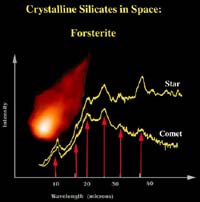
Paris - February 7, 2000 - Silicate crystals, the most abundant minerals on Earth, are also found in great quantities around old stars and in protoplanetary discs -the discs where planets form. This finding, presented last week at a press conference at ESA's Villafranca station in Madrid, is considered by experts in space chemistry as one of the main results of ESA's infrared space telescope, ISO. Silicate minerals were known to be a main component of dust in space, but detecting them in a crystallised state has been a surprise. It allows the identification of precise silicates in astronomical objects, which will open "a totally new field in astronomy: astro-mineralogy. This is the crystalline revolution", said the author, Dutch astronomer Rens Waters of Amsterdam university. "It's really fantastic, this possibility of identifying the silicates. Before ISO everybody thought that all silicates in space were amorphous, without a well-ordered internal structure; that means you cannot differentiate among the many different silicates existing. Now we can try to identify them and track their presence in different regions. A whole new research field is starting", said Rens Waters, who brought to the press conference samples of several terrestrial crystalline silicates: olivine and pyroxene, the most common silicates on Earth. Crystals give key clues about the physical conditions and evolutionary history of crystal-bearing objects. The precise mechanisms for crystal-making are now being researched now very actively in the laboratories, although some working-hypotheses are already being used. For instance, crystals can be made by heating the material to temperatures above 1 300 degrees Centigrade and then cooling it down slowly. Those found so far by ISO are at -170 degrees Centigrade, both in stellar envelopes and in protoplanetary discs. In the case of the old stars - red giant stars, where crystals are found to account for as much as 20% of all the surrounding dust, astronomers think that that the high temperatures near the star triggered the crystallisation of the silicates. In the protoplanetary discs some experts postulate that electric shocks - like lightning flashes - heated the dust, which cooled afterwards. "The crystals detected by ISO in these discs have a size of about a thousandth of a millimetre. They collide with each other, forming bigger and bigger bodies. Models predict that in about ten to one hundred million years they will make planets", Waters says. "In fact, crystalline silicates are very common in our own Solar System. You also have them in the comet Hale Bopp!". The reason why crystalline silicates had not been detected before in stars has to do with their low temperatures. Cold material emits mostly infrared light, which means an infrared space telescope like ESA's ISO was needed. The two high-resolution spectrometers on-board the satellite, able to detect the 'chemical fingerprint' of the crystals, did the rest. Astronomers are sure about the discovery because those chemical fingerprints, the spectra, can be compared in laboratories with spectra from crystalline silicates found on Earth. This method has demonstrated the crystalline structure and has even already allowed the identification of some of the crystals, such as forsterite and enstatite. However, crystalline silicates are a large family and their chemical signatures can be very similar; to enlarge the list of precise crystals more work will be needed, say experts in space chemistry. That is just one of the open questions requiring lab work. There's at least another one: crystalline silicates are found around old stars, in protoplanetary disks and in our own Solar System, but not in the space among the stars; astronomers can't explain it yet. "Crystalline silicates are synthesised around the stars; then that dust goes into the interstellar space, and enriches the raw material out of which more stars and planets will form. So you would expect crystals also to be in the interstellar medium! Crystals will certainly make us learn a lot...", says Waters. "This finding shows that ISO is really unveiling the chemistry of the universe", says ESA astronomer Alberto Salama, chairman of the workshop about ISO results in spectroscopy held this week at ESA's Villafranca station in Madrid where the results were presented to the scientific community. "This is becoming more and more a 'hot field' of research. Initially we intended to organise a modest workshop, but we have had 150 astronomers coming from all over Europe!".
Email This Article Comment On This Article Related Links Space
 Satellite Launch To Boost DTH In India
 Calcutta, India (SPX) Dec 28, 2005
The successful launch Thursday of India's heaviest satellite from spaceport of Kourou in French Guyana may have boosted the country's space research efforts to yet another level, but it has also lifted the spirits of at least three Direct-To-Home televisions broadcasters, one of which has been waiting for years to launch its services in India.
--------------------------------------------------------- It's new. And it's downright terrific! Celestron's CPC Schmidt-Cassegrain telescope is the scope you've been waiting for! It offers new alignment technology, advanced engineering, and bold new design at a new, low price! In fact, Celestron's Professional Computerized (CPC) scope with revolutionary SkyAlign Alignment Technology redefines everything that amateur astronomers are looking for. It offers quick and simple alignment, GPS technology, unsurpassed optical quality, ease of use, advanced ergonomics, enhanced computerization and, most important, affordability. Want to view M-31 tonight? One button takes you there!
Shop for telescopes online at Telescopes.com! today!
|
|
|

|
|
|
|
|
|
|
|
|
|
|
|
| The content herein, unless otherwise known to be public domain, are Copyright 1995-2006 - SpaceDaily.AFP and UPI Wire Stories are copyright Agence France-Presse and United Press International. ESA PortalReports are copyright European Space Agency. All NASA sourced material is public domain. Additionalcopyrights may apply in whole or part to other bona fide parties. Advertising does not imply endorsement,agreement or approval of any opinions, statements or information provided by SpaceDaily on any Web page published or hosted by SpaceDaily. Privacy Statement |