|
 |
 |
 |
 |
 |
 |
 |
 |

 |
The Cruise Phase Continues
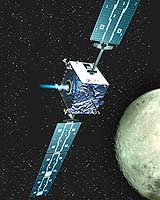
Paris (ESA) Jul 19, 2004 Smart-1 is now flying its 314th orbit, in good status and with all functions performing nominally. The new thrusting strategy is well in progress with thrust arcs around perigee for about one third of every revolution. Presently the thrust arcs last for about 27 hours out of an orbital period of 81 hours. The thrust duration will progressively increase to a longest thrust arc of 41.5 hours starting on 10 August at 12:52, when the orbit period will be about 120 hours (5 days). The Electric Propulsion power is operating at 1358 W, as the power margins on the spacecraft are rather comfortable and operating at a higher power level saves fuel. The Earth has now passed the aphelion point of its orbit around the Sun. As indicated in the graph below there has been a steady decline in the power output of the solar array since perihelion in January. The electric propulsion thruster still exhibits some variation in thrust, caused by the varying amplitude of the anode current oscillation. No Optocoupler Single Event Transients, causing the flame-out, have been observed during this period. Up to 3 July, and the 248th engine pulse, the ion-engine had cumulated a total ON time of about 2643 hr, consumed about 41.6 kg of Xenon and imparted to the spacecraft a velocity increment of about 1930 ms-1. In status report #24, 11 June 2004, a slight degradation in performance of Transmitter A, as measured by on-board telemetry parameters, was indicated. In an initial attempt to understand the problem an experiment to measure the electromagnetic power radiated to ground by Transmitter A, compared to Transmitter B has now taken place. This required a special orbital configuration and careful procedures to be in place. The test confirmed that the Transmitter A is about 1 dB (1 W) weaker than Transmitter B. Experts are making further investigations. Community Email This Article Comment On This Article Related Links Smart 1 at ESA SpaceDaily Search SpaceDaily Subscribe To SpaceDaily Express Stellar Chemistry, The Universe And All Within It
 Sloan Survey Identifies New Dwarf Galaxy Inside Milky Way
 Washington DC (SPX) Jan 10, 2006
Astronomers using the Sloan Digital Sky Survey have discovered a previously unknown cluster of stars within the Milky Way that appears to be a separate dwarf galaxy being consumed by its much larger neighbor. |
|
|

| The content herein, unless otherwise known to be public domain, are Copyright 1995-2006 - SpaceDaily.AFP and UPI Wire Stories are copyright Agence France-Presse and United Press International. ESA PortalReports are copyright European Space Agency. All NASA sourced material is public domain. Additionalcopyrights may apply in whole or part to other bona fide parties. Advertising does not imply endorsement,agreement or approval of any opinions, statements or information provided by SpaceDaily on any Web page published or hosted by SpaceDaily. Privacy Statement |