|
 |
 |
 |
 |
 |
 |
 |
 |

 |
The Best View Of The Tour Is From Space
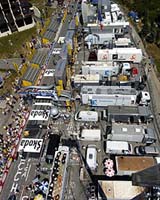
Paris (ESA) Jul 26, 2004 It is now possible to track the position and speed of each rider in the Tour de France in real-time thanks to the EGNOS European satellite positioning system, a preparatory programme for the Galileo system.
Pinpoint positioning This is useful information for Tour fans who want to know how their favourite rider is placed, but also for team directors who want constant updates on their star performers and their opponents, or who want to be able to analyse the race afterwards together with the riders. The information is also of great value to the organisers, notably for security reasons, giving them an overall perspective on how stages are unfolding complete with all the exact positions. This data will be available on the Internet, on the Tour de France channel or will be broadcast by television channels even when they have no presence on the ground.
Satellite navigation This new approach to the competition is made possible by the use of data from EGNOS (European Geostationary Navigation Overlay Service), a European Space Agency-developed network made up of satellites and ground stations which correct and augment data provided by the US Global Positioning System (GPS). In its current form, the (military) GPS system is neither accurate nor reliable enough for the task in hand, while EGNOS, operational as of this summer, provides the accuracy and continuity required to show positions with precision. By 2009, this level of performance will have been given a further boost with the deployment of Galileo, the first civil global satellite navigation system to be funded by the European Space Agency and European Commission.
System trials at Alpe d'Huez For this first ever trial, 10 riders were fitted with receivers and tracked by the EGNOS network, with team directors' vehicles trailing close behind each rider. It was thus possible to monitor the precise gaps between riders and even, for some of them, to model their ascent over the entire 15 kilometres of this legendary stage, visualising for example the efforts of Lance Armstrong as he negotiated the 21 bends leading to the top of l'Alpe d'Huez and comparing his ascent to those of other riders. Eventually the intention is to fit a receiver to each rider and thus to monitor the exact positions of all the cyclists taking part.
Seeing all the riders The accuracy of EGNOS is such that the position of any moving object equipped with a receiver can be pinpointed to within a metre. It will be possible, against the backdrop of a 3-D visualisation of the countryside, to watch the progress of each rider through all the stages of the Tour. This information will be an invaluable addition to television broadcasts, which are unable to show all the riders. Thus, a combination of precise topographical data and data on the position of each rider will provide an extremely accurate picture of the race as each stage phase unfolds. With this kind of system each broadcaster will for example be able to have a dedicated channel on which viewers choose which rider they want to watch without needing to have a camera trained on each cyclist. This new service is under development in the framework of a partnership between the European Space Agency, Tour de France organiser, ASO, and computer graphics firm, Trimaran. Community Email This Article Comment On This Article Related Links Tour de France SpaceDaily Search SpaceDaily Subscribe To SpaceDaily Express Earth Observation News - Suppiliers, Technology and Application
 New Legislation Initiated To Support Commercial Remote Sensing Industry
 New York NY (SPX) Jan 11, 2006
The importance of remotely sensed data and technologies to support natural disasters has prompted attention and action in Washington. New initiatives and legislation authorizing appropriations to the remote sensing industry will be discussed at Strategic Research Institute's U.S. Commercial Remote Sensing Industry conference, scheduled for February 9-10, 2006 in Washington D.C. |
|
|

| The content herein, unless otherwise known to be public domain, are Copyright 1995-2006 - SpaceDaily.AFP and UPI Wire Stories are copyright Agence France-Presse and United Press International. ESA PortalReports are copyright European Space Agency. All NASA sourced material is public domain. Additionalcopyrights may apply in whole or part to other bona fide parties. Advertising does not imply endorsement,agreement or approval of any opinions, statements or information provided by SpaceDaily on any Web page published or hosted by SpaceDaily. Privacy Statement |