|
 |
 |
 |
 |
 |
 |
 |
 |

 |
The Antarctic Deep Sea Gets Colder
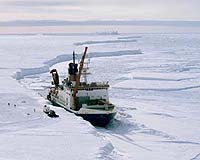
Bremerhaven, Germany (SPX) Apr 29, 2008 The Antarctic deep sea gets colder, which might stimulate the circulation of the oceanic water masses. This is the first result of the Polarstern expedition of the Alfred Wegener Institute for Polar and Marine Research in the Helmholtz Association that has just ended in Punta Arenas/Chile. At the same time satellite images from the Antarctic summer have shown the largest sea-ice extent on record. In the coming years autonomous measuring buoys will be used to find out whether the cold Antarctic summer induces a new trend or was only a "slip". The Polarstern expedition ANT-XXIV/3 was dedicated to examining the oceanic circulation and the oceanic cycles of materials that depend on it. Core themes were the projects CASO (Climate of Antarctica and the Southern Ocean) and GEOTRACES, two of the main projects in the Antarctic in the International Polar Year 2007/08. Under the direction of Dr. Eberhard Fahrbach, Oceanographer at the Alfred Wegener Institute, 58 scientists from ten countries were on board the research vessel Polarstern in the Southern Ocean from 6 February until 16 April, 2008. They studied ocean currents as well as the distribution of temperature, salt content and trace substances in Antarctic sea water. "We want to investigate the role of the Southern Ocean for past, present and future climate," chief scientist Fahrbach said. The sinking water masses in the Southern Ocean are part of the overturning in this region and thus play a major role in global climate. "While the last Arctic summer was the warmest on record, we had a cold summer with a sea-ice maximum in the Antarctic. The expedition shall form the basis for understanding the opposing developments in the Arctic and in the Antarctic," Fahrbach said. In the frame of the GEOTRACES project the scientists found the smallest iron concentrations ever measured in the ocean. As iron is an essential trace element for algal growth, and algae assimilate CO2 from the air, the concentration of iron is an important parameter against the background of the discussion to what extent the oceans may act as a carbon sink. As the oceanic changes only become visible after several years and also differ spatially, the data achieved during the Polarstern expeditions are not sufficient to discern long-term developments. The data gap can only be closed with the aid of autonomous observing systems, moored at the seafloor or drifting freely, that provide oceanic data for several years. "As a contribution to the Southern Ocean Observation System we deployed, in international cooperation, 18 moored observing stations, and we recovered 20. With a total of 65 floating systems that can also collect data under the sea ice and are active for up to five years we constructed a unique and extensive measuring network," Fahrbach said. In order to get the public, and especially the young generation, interested in science and research and to sensitise them for environmental processes, two teachers were on board Polarstern. Both took an active part in research work and communicated their experiences to pupils, colleagues and the media via internet and telephone. "We will bring home many impressions from this expedition, and we will be able to provide a lively picture of the polar regions and their impact on the whole earth to the pupils," Charlotte Lohse, teacher at the Heisenberg-Gymnasium in Hamburg, and Stefan Theisen from the Free Waldorf School in Kiel said. Community Email This Article Comment On This Article Related Links Alfred Wegener Institute for Polar and Marine Research in the Helmholtz Association Beyond the Ice Age
 NASA Researcher Visits One Tough P.I.G.
 Greenbelt MD (SPX) Apr 15, 2008
Robert Bindschadler is chief scientist of NASA's Hydrospheric and Biospheric Sciences Laboratory, a senior fellow of the Goddard Space Flight Center, a fellow of the American Geophysical Union and a past president of the International Glaciological Society. This past January, Bindschadler led an expedition to a previously untouched part of Antarctica that may be one of the best places to gauge how global warming is affecting the continent. |
|
|

| The content herein, unless otherwise known to be public domain, are Copyright 1995-2007 - SpaceDaily.AFP and UPI Wire Stories are copyright Agence France-Presse and United Press International. ESA Portal Reports are copyright European Space Agency. All NASA sourced material is public domain. Additional copyrights may apply in whole or part to other bona fide parties. Advertising does not imply endorsement,agreement or approval of any opinions, statements or information provided by SpaceDaily on any Web page published or hosted by SpaceDaily. Privacy Statement |