|
 |
 |
 |
 |
 |
 |
 |
 |

 |
The Answer's To Space Technology Are In The Spheres
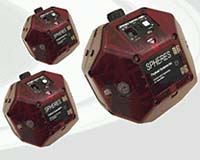
Boston - June 23, 2003 Payload Systems has delivered the first installment of parts for the much-anticipated Spheres (Synchronized Position Hold, Engage and Reorient Experimental Satellites) testbed to NASA. The delivery marks the culmination of five years of research, design and development and will be followed by a subsequent delivery of additional hardware and software in the fall of 2003. Spheres is projected to be delivered to the International Space Station (ISS) by the space shuttle in 2004. "This delivery is a very significant milestone for Payload Systems and the entire team," said Spheres Project Manager, Steve Sell. "It is extremely exciting to begin to see the results of years of excellent collaboration between Payload Systems and the MIT Space Systems Laboratory students and staff. This also marks the Spheres testbed's transition from ground development to spaceflight operations." The Spheres project began in 1998 as a challenge assignment in an experimental three-semester undergraduate design course at MIT entitled "Conceive, Design, Implement, and Operate" (CDIO), in which students were asked to design, build and test their own prototype satellite research system. Payload Systems provided students with instruction and technical support, and also gave operational guidance when the students tested their prototypes on the NASA KC-135 reduced gravity simulation aircraft. This proof of concept stage was so successful that MIT made CDIO a regular course offering and DARPA (Defense Advanced Research Projects Agency) provided funding to develop the Spheres concept into a spaceflight system. Additional funding has been provided by the NASA Goddard Space Flight Center, the NASA Jet Propulsion Laboratory, and MIT. For the spaceflight version of Spheres, Payload Systems took over all systems design, development, testing, and certification responsibilities. CDIO student Stephanie Chen joined Payload Systems after graduating from MIT, and continues to work on the Spheres project. "I am very excited to be working on a project that will enable research for such a broad range of future applications," she said. "There is no way to foresee today all of the significant discoveries that Spheres will enable to happen." Specifically, Spheres is designed to support breakthrough research on complicated multiple-satellite operations, such as service and repair, formation flight, and distributed functionality, and for applications that include high-precision earth observation, deep space astronomy, and telecommunications. The Spheres testbed consists of three self-contained satellites, each with battery power, a cold gas propulsion system, and onboard communications and navigation equipment. The satellites autonomously navigate within a designated work area inside ISS by individually measuring their respective positions and attitudes in relation to one another and to the defined volume. Spheres provides a unique opportunity for researchers on the ground to test control algorithms on ISS, receive testing data, then refine and uplink new algorithms in a relatively short period of time, thus contributing to an accelerated iterative research process unavailable in other testing environments. "MIT has worked closely with Payload Systems on several ambitious projects, and every time the results have exceeded my expectations," said Dr. David Miller, Director of the MIT Space Systems Laboratory. "As an educational project, Spheres has already been an enormous success, and as an operational spaceflight system, we expect it will encourage an entirely new class of research programs." Community Email This Article Comment On This Article Related Links Spheres at MIT Payload Systems SpaceDaily Search SpaceDaily Subscribe To SpaceDaily Express Microsat News and Nanosat News at SpaceMart.com
 Small Satellite Solutions From Scotland
 Clyde, Scotland (SPX) Jan 12, 2006
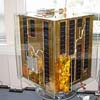
Clyde Space are offering the growing ranks of small satellite manufacturers power subsystem solutions for their missions. Based in purpose built facilities on West of Scotland Science Park in Glasgow, Clyde Space has a range of power subsystems for missions from as little as 1W up to in excess of 2.5kW. |
|
|

| The content herein, unless otherwise known to be public domain, are Copyright 1995-2006 - SpaceDaily.AFP and UPI Wire Stories are copyright Agence France-Presse and United Press International. ESA PortalReports are copyright European Space Agency. All NASA sourced material is public domain. Additionalcopyrights may apply in whole or part to other bona fide parties. Advertising does not imply endorsement,agreement or approval of any opinions, statements or information provided by SpaceDaily on any Web page published or hosted by SpaceDaily. Privacy Statement |