
 |
 |
 |
 |
 |
 |
 |
 |
 |

 |
Testing Times For Robotic Explorers On Mars
for Astrobiology Magazine Moffett Field (SPX) May 09, 2008 Many space missions use robots to explore. The rovers Spirit and Opportunity are still travelling around Mars, taking pictures and digging in the dirt. But could a robot identify alien life? How would a machine know the difference, for instance, between a rock and bacteria? Hoping to answer this question, a group of scientists, led by Derek Pullan of the University of Leicester, used robotic explorer instruments to examine rocks. To make their tests as realistic as possible, the researchers collected rock samples similar to what we'd find on Mars and then studied them with high-tech equipment. The instruments - which included a camera, microscope, and sampling device -- were very similar to those carried on the lost Beagle 2 probe. The idea was to see if the instruments could detect signs of living creatures in the rocks. Although the tests were carried out in a lab, the scientists made the conditions as close as possible to those experienced by probes on the martian surface.
The Whole Picture The Beagle 2-style microscope was found to be particularly good, showing that low-budget equipment can be as effective as expensive options. The team also got useful data about how close in proximity to a sample rock particular instruments should be in order to spot signs of life.
The Problem with Probes They also must be energy efficient, since their power is mostly generated from solar panels. This combines to make designing instruments for them very difficult. For example, you might think that a robot exploring Mars should have the most powerful microscope available. That's probably not possible as everything must be low-weight, small in size, need little power and also be very tough. Clearly instrument engineers have a hard job, and the scientists wanted to see whether the current equipment is up to the task. More studies like this are planned for field experiments and sample preparation, as part of the Planetary Analogue Field Studies Network. The research is useful not only for instrument designers, but also for mission engineers and planetary scientists. The team plans to do further tests with different equipment, building up a database that will show which instruments are best in any given situation. It all goes toward helping make future missions to Mars as effective as possible. Indeed, if we do find life on another planet, the discovery will be likely made by a machine and not a human. Full details about this research can be found in the volume 8, number 1, 2008 edition of the journal Astrobiology. Community Email This Article Comment On This Article Share This Article With Planet Earth
Related Links Mars Rovers at JPL Mars Rovers at Cornell Mars News and Information at MarsDaily.com Lunar Dreams and more
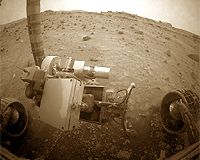
 Opportunity Investigates Arthritic Rover Joint
 Pasadena CA (SPX) May 07, 2008
Opportunity is healthy and all subsystems are performing as expected, with the exception of the Instrument Deployment Device (the robotic arm). Power has improved slightly during the last week, primarily as the result of a better state of charge in the batteries. |
|
|

| The content herein, unless otherwise known to be public domain, are Copyright 1995-2007 - SpaceDaily.AFP and UPI Wire Stories are copyright Agence France-Presse and United Press International. ESA Portal Reports are copyright European Space Agency. All NASA sourced material is public domain. Additional copyrights may apply in whole or part to other bona fide parties. Advertising does not imply endorsement,agreement or approval of any opinions, statements or information provided by SpaceDaily on any Web page published or hosted by SpaceDaily. Privacy Statement |
 del.icio.us
 Digg
Digg Reddit
 YahooMyWeb
 Google
 Facebook