|
 |
 |
 |
 |
 |
 |
 |
 |

 |
Testers Evaluate Helmet-Mounted Display in Cockpit
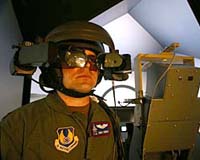
Edwards AFB CA (AFNS) Jun 30, 2006 What if a pilot could turn in any direction, but still have access to the information displayed on the heads-up display at the front of the cockpit? That's the question members of the 412th Test Wing answered when they completed a project June 20 to help evaluate a helmet-mounted display system for the F-35 Joint Strike Fighter. "The F-35 helmet is essentially replacing the conventional heads-up display in the fighter cockpit," said U.S. Air Force Capt. Chris Jenkins, pilot vehicle interface lead for the F-35 Joint Strike Fighter Program Integrated Test Force. "When you get in an F-16, for example, you have a heads-up display in front of the pilot that provides all the primary flight reference and weapons information," he explained. "With the Joint Strike Fighter helmet you now have the capability to take the information anywhere you look outside the aircraft, not just forward." Jenkins said this project was designed to study risk reduction while using helmet-mounted display. "One of the challenges of having a helmet-mounted system on the aircraft is optimizing the information so the pilot can actually see the outside world through all the symbology," he noted. "With a traditional heads-up display, the pilot can reference the information in one spot, look around without any kind of obstruction, see what they want to see real world, and then come back to the heads-up display," Jenkins emphasized. "With the helmet, the pilot has that kind of information in his face all the time, unless it's turned off." He said the Joint Strike Fighter helmet system uses the normal heads-up display symbology when the pilot is looking straight ahead, but a tracker senses when the pilot looks away from the centerline and tells the display to turn off some information or turn on other information. "As the pilot looks between these two views, the helmet has to optimize the information to make the transition smooth," Jenkins said. "If it's not done right, the presentation is confusing between the two views, and there could be spatial disorientation." "This would be compounded at night when there aren't any visual cues," he continued. "That's why it's important to get this right." Getting it right presented a special challenge, the team members said. The Joint Strike Fighter simulators used here weren't equipped for a helmet, and the actual Joint Strike Fighter helmet wasn't available, so they had to integrate a commercially available helmet into the simulator. "We've integrated, in a very short time, a commercial helmet to look at helmet-mounted display risk-reduction projects," Jenkins said. "One thing that's very important is that with this capability integrated into the helmet, instead of waiting for a real flight-worthy helmet to come from Lockheed, we were able to go ahead and look at some risk-reduction research." This can possibly save the program money down the road by identifying some of the constraints of the system early," he noted. "We can work out some of those issues now by integrating the helmet into the representative cockpit." Orion Westfall, a computer scientist with the 412th Electronic Warfare Group, built the software and systems to perform the tests. "Captain Jenkins brought down a set of requirements in a manual form, showing all the symbology on paper," he said. "I had to program that up, make it move with the pilot and with the airplane, then build the control panel." The system Westfall built to run the helmet-mounted display has three computers, one to run the control panel and one for each of the pilot's eyes. "You're using both eyes, so it's stereo vision," he said. "When you put the helmet on you can actually change the depth of the symbology display." Westfall said this was a requirement, because everyone's eyes are different. "When the pilot gets in and puts the helmet on, if the symbology isn't right for his eyes, he has to be able to adjust that forward or back." Interpupillary spacing, or the distance between the eyes, also had to be considered. "That was quite a challenge," Westfall said. "I'm pretty proud of what we've accomplished here. The helmet-mounted display is a pretty unique piece of equipment." Jenkins said the integration of the helmet-mounted display into the Joint Strike Fighter will give pilots an extra edge in combat. "It really increases the pilot's situational awareness and gives him greater flexibility for being able to acquire targets of interest," he said. "From a tactics point of view, that gives the pilot an advantage to now look over his shoulder, find a target of interest, slew a missile to that target and shoot without ever having to turn the aircraft, which is a very limited capability in a conventional fighter." U.S. Air Force Lt. Col. Ed Cassidy, Joint Strike Fighter ITF commander said the technology that Jenkins, Westfall and others at Edwards' simulator facility are testing is critical to providing future fighter pilots with better situational awareness. "This is a risk-reduction test. We are taking an early look at this symbology to ensure we are heading in the right direction," Cassidy said. "Early testing of the capability to display all this information just inches from the pilots' eyes will pave the way for testing the actual helmet in the actual airplane." Community Email This Article Comment On This Article Related Links - The latest in Military Technology for the 21st century at SpaceWar.com
 Boeing Awarded B-52H Weapons Integration Contract
 St Louis MO (SPX) Jun 30, 2006
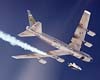
Boeing has received a U.S. Air Force contract worth up to $150 million to support new weapons integration efforts on the B-52H bomber. Work on the B-52 Smart Weapons Integration Next Generation (SWING) will be performed by engineers based at the company's Integrated Defense Systems facility in Wichita, Kansas. The contract expires December 2020. |
|
|

| The content herein, unless otherwise known to be public domain, are Copyright 1995-2006 - SpaceDaily.AFP and UPI Wire Stories are copyright Agence France-Presse and United Press International. ESA PortalReports are copyright European Space Agency. All NASA sourced material is public domain. Additionalcopyrights may apply in whole or part to other bona fide parties. Advertising does not imply endorsement,agreement or approval of any opinions, statements or information provided by SpaceDaily on any Web page published or hosted by SpaceDaily. Privacy Statement |