|
 |
 |
 |
 |
 |
 |
 |
 |

 |
Terror Adds $20 To Oil Price - Report
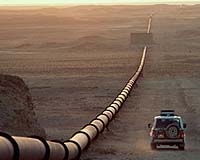
Washington (UPI) Oct 17, 2005 Sabotage attacks on oil facilities worldwide have put an extra $20 a barrel on the price of oil, a new Israeli survey has claimed. Since the end of the major hostilities in Iraq, there have been close to 300 attacks on pipelines, refineries, and other facilities there, says the report by the Institute for Contemporary Affairs in Jerusalem. The report also notes that there have been attacks on oil installations in many other parts of the world, including Chechnya, Pakistan, India, Russia, Azerbaijan, and Nigeria. "The cumulative impact of those attacks amounts to about 1 million barrels a day that has been taken off the market as a result of sabotage. If these million barrels a day had reached the market, oil prices would have been at least $20 a barrel lower," the report says. Titled 'The World Oil Crisis: Implications for Global Security and the Middle East,' the report was authored by Gal Luft, Executive Director of the Institute for the Analysis of Global Security, and a former lieutenant colonel in the Israel Defense Forces, who served as a military liaison to the Palestinian authority. "The global oil market environment of very strong demand and very little spare capacity offers a huge opportunity to the radical jihadists. The terrorists believe that the best way to hurt the global Western economy is to go after oil," Luft notes. The report also says that the oil price rise has resulted in "a transfer of wealth of historic proportions from the economies of the United States, Japan, China, and Europe to the economies of the oil-producing countries." This carries a profound implication for Western security, Dr Luft adds, since it means that "the side that needs to defeat terrorism and radical Islam is constantly enriching the enemy". Moreover, the new global oil market is widening the political and security options of Middle East oil producers, since countries like China and India, representing giant new markets, are seeking to make deals and build alliances. Iran, for example, is expecting Chinese diplomatic support to help prevent the U.S. and its European allies from referring Iran's nuclear program to the United Nations Security Council for possible sanctions, having just concluded a $70 billion oil and gas deal with Chinese corporations. "The oil crisis we face today is not the supply-driven crisis we had in 1973. This is a demand-driven crisis, due in large measure to increased demand for oil in China and India," the report says. "Their need for energy has caused a chain reaction, since this has almost totally eliminated the oil market's spare production capacity of about five million barrels a day that Saudi Arabia and other countries could produce in times of emergency to stabilize the market." "Today there is a very thin layer of insulation in the oil market amounting to approximately one million barrels a day, meaning that every small disruption, be it a hurricane in the Gulf of Mexico or riots in Nigeria or instability in the Middle East, immediately creates a rise in prices. This situation will be with us for a long time because there is no new spare capacity. "Building spare capacity requires an investment of billions of dollars to create infrastructure that may sit idle most of the time. Nobody will invest on those terms," Luft adds. The report concludes that this double effect of rising demand for oil and little spare capacity offers to the radical Islamists the opportunity to hurt the Western economy by targeting pipelines, refineries, pumping stations and tankers. "They realize that when they blow up a pipeline in Iraq or in Sudan or anywhere in the world, this translates immediately into a price rise in all the markets. It is much easier for terrorists to blow up an oil facility or take out a tanker somewhere in the world than to infiltrate into the United States and blow up the World Trade Center," Luft says. The new global oil market is already constraining U.S. foreign policy options, the report suggests. When the UN Security Council tried to impose sanctions on Sudan -- one of China's main oil suppliers -- over the issue of Darfur, the Chinese blocked the move. As in the case of its deals with Iran, China's energy interest trumped their interest in being good neighbors within the international community. China again intervened in the new energy basin of Central Asia, after the alleged massacre of civilian protesters in Uzbekistan. The United States and Europe sought an international investigation, but China, which had signed a $600 million gas deal with Uzbekistan, refused. The Uzbek authorities then gave the United States 180 days notice to close its airbase at Karshi Khanabad, a long-standing goal of Chinese foreign policy. "So we see how oil shapes foreign policy," the report concludes. "Access to energy resources will shape the world in the years to come. It will dictate the international behavior of countries as it plays an increasing role in relations between the major powers. We will see new alliances forged, such as between China and Saudi Arabia." On a closing note, the report warns that Israel should be "very sensitive to developments between the United States and China, and should be very careful in pursuing military relations with China because there will be a cost. There are a lot of things that can be done with China on many issues, but for Israel to pursue military relations with China at a time when very important parts of the U.S. defense establishment and Congress are extremely hawkish on China is a very dangerous game to play." Community Email This Article Comment On This Article Related Links SpaceDaily Search SpaceDaily Subscribe To SpaceDaily Express The Long War - Doctrine and Application
 SAIC to Provide Bio-Surveillance Software, Data Analysis for Centers for Disease Control
 Atlanta GA (SPX) Dec 09, 2005
Science Applications International Corporation (SAIC) announced Thursday it was awarded two contracts in support of the Centers for Disease Control and Prevention (CDC) National Center for Public Health Informatics' BioSense program. |
|
|

| The content herein, unless otherwise known to be public domain, are Copyright 1995-2006 - SpaceDaily.AFP and UPI Wire Stories are copyright Agence France-Presse and United Press International. ESA PortalReports are copyright European Space Agency. All NASA sourced material is public domain. Additionalcopyrights may apply in whole or part to other bona fide parties. Advertising does not imply endorsement,agreement or approval of any opinions, statements or information provided by SpaceDaily on any Web page published or hosted by SpaceDaily. Privacy Statement |