
 |
 |
 |
 |
 |
 |
 |
 |
 |

 |
Telescope Sees Universe Through Gamma-Ray Eyes
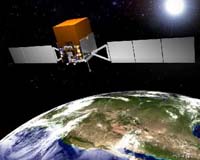
Stanford CA (SPX) Jul 10, 2008 The scientists have stopped holding their breath. Three weeks after the launch of the Gamma-ray Large Area Space Telescope (GLAST), researchers from Stanford University, the Stanford Linear Accelerator Center and elsewhere have shaken awake the scientific instruments aboard their $690 million satellite, 350 miles above Earth, for the first time. And everything's working. On the Large Area Telescope, the principal instrument on GLAST, the computers booted up properly, the 16 gamma-ray detectors came to life, and communications checked out well. The observatory's navigation system is following directions from the ground to turn toward interesting objects. "I've been watching space projects for 30 years or so and I've never seen one go as smoothly as this one," said Roger Blandford, the director of the Kavli Institute for Particle Astrophysics and Cosmology, which is housed both on the main Stanford campus and at the Stanford Linear Accelerator Center (SLAC). The telescope will see the normally invisible gamma rays from stars and other cosmic objects and offer a more complete view of some of the most violent events in the universe. GLAST will study, among other things, enormously powerful gamma-ray bursts, strange beams of charged particles from spinning black holes and pulses of energy from spinning neutron stars. It may even find the gamma-ray signature of dark matter, the unseen material that may hold the universe together. Data from the satellite already has begun flowing to the Instrument Science Operations Center at SLAC, where it is used to calibrate the telescope for the work ahead. The telescope is weeding out unwanted cosmic rays and measuring the first of the billion or so gamma rays it should eventually see from cosmic sources. Some 30 collaboration members from around the world have come to SLAC to assist in the commissioning phase to bring the Large Area Telescope to its mission-ready performance. "Everybody's really happy," said Rob Cameron, the manager of the SLAC operations center. "We've got plenty of work to do. We've got to calibrate the instrument, tune it up to prepare it for science." GLAST is a NASA project, a consortium of six countries and 14 U.S. research institutions. At Stanford, project members come from SLAC, a U.S. Department of Energy laboratory; the Physics Department; the Hansen Experimental Physics Laboratory; and the Kavli Institute for Particle Astrophysics and Cosmology. Community Email This Article Comment On This Article Share This Article With Planet Earth
Related Links NASA GLAST Site Space Telescope News and Technology at Skynightly.com
 GLAST Mission Operations At NASA Goddard Powered Up
 Greenbelt MD (SPX) Jul 03, 2008
Several bases of operations for NASA's Gamma-ray Large Area Space Telescope (GLAST) are gearing up for data from the recently launched satellite. |
|
|

| The content herein, unless otherwise known to be public domain, are Copyright 1995-2007 - SpaceDaily.AFP and UPI Wire Stories are copyright Agence France-Presse and United Press International. ESA Portal Reports are copyright European Space Agency. All NASA sourced material is public domain. Additional copyrights may apply in whole or part to other bona fide parties. Advertising does not imply endorsement,agreement or approval of any opinions, statements or information provided by SpaceDaily on any Web page published or hosted by SpaceDaily. Privacy Statement |
 del.icio.us
 Digg
Digg Reddit
 YahooMyWeb
 Google
 Facebook