|
 |
 |
 |
 |
 |
 |
 |
 |

 |
Teets Tells Congress Lasers-Based Communications Coming
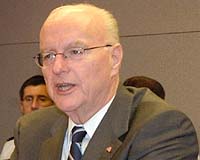
Washington DC (SPX) Mar 15, 2005 The military's senior adviser on space, Peter B. Teets, testified before Congress on March 8. Teets, who serves as both the acting secretary of the Air Force and the Department of Defense's executive agent for space, spoke to the House Armed Services Committee subcommittee on strategic forces about the importance of programs like space radar and the transformational communications satellite. "I believe there is a strong need for us to provide persistent intelligence collection to combatant commanders day and night in all weather conditions," Mr. Teets said. "Only space radar can do that. In open areas and in denied areas, space radar can provide us with persistent intelligence collection." Providing that persistent intelligence to commanders in the field will require a constellation of satellites launched into space. Each satellite will use radar to take pictures of the earth, through any kind of weather, to provide both military and civilian intelligence communities information about what is happening on the ground and over the hill ahead, officials said. Mr. Teets said he recently directed the restructure of the Space Radar program, consolidating it in the Washington D.C. area, to create a tighter-knit community between the civilian and military agencies that will benefit from it. "We have restructured the space radar program in a way that will allow us to move forward in a team sense - military community and intelligence community - to use the same satellites to provide information for warfighting operations as well as for intelligence analysis," he said. "I think our restructured space radar program will indeed allow us to achieve those goals." One short term goal of the program is to demonstrate the capability of the system by launching a quarter-scale model satellite by 2008. The knowledge learned from that launch and from working with the satellite during its test phase will help the program develop larger operational systems, Mr. Teets said. "It will mature the technology," he said. "The transmitter/receiver we will use in the demo satellites will be used for the full operationally capable satellites as well. "We will demonstrate that technology and demonstrate the cost of producing roughly a quarter-scale model spacecraft. We will have a high confidence then of what it will cost us to ultimately field the operationally responsive satellite." Mr. Teets said the department plans for the first space radar satellite to be launched in 2015. Also critical to the DOD space program is development of the Transformational Communications Satellite program. This program will create larger bandwidth for use by the DOD in both war and peace time. Bandwidth describes how much electronic information can be passed through a communications device at any time. More bandwidth means more information, and a greater capacity to serve more people at one time, Mr. Teets said. "The bandwidth we talk about is enormously important," he said. "We are going to be able to serve this communications on the move. We will have to service thousands of users simultaneously around the globe." New developments in communications include laser communications -- the exchange of information between two points on a beam of light. Mr. Teets told Congressmen the DOD had conducted a test of the concept in New Mexico. The experiment had been successful, he said, because it showed the possibility of laser communications between both space and a ground station and space and a flying aircraft. With the advent of transformational satellite program combined with laser communications, the Department of Defense will gain an enormous increase in bandwidth, Mr. Teets said. "Today our satellites are operating with higher bandwidth of about a factor of 10 than they were just a few years ago," he said. "We will get another factor of 10 when advanced extremely high frequency launches along with wide-band gap filler. And there is a third order of magnitude of bandwidth increase when we go to laser communications." That bandwidth will be used by Soldiers in the field to get the critical information they need to do their job and to stay ahead of the enemy, Mr. Teets said. "When somebody wants a map of the area in front of (him), that can be requested in a way that will have enough bandwidth capability to get that map to him in seconds," he said. While the satellite program is in development, DOD officials use commercially procured bandwidth to conduct some operations. Mr. Teets told lawmakers the services have agreed to come together to work on developing policy to define its use of that bandwidth. Community Email This Article Comment On This Article Related Links SpaceDaily Search SpaceDaily Subscribe To SpaceDaily Express Military Space News at SpaceWar.com
 Space Group To Activate New Unit
 Colorado Springs CO (SPX) Jan 6, 2006
Air Force Reserve Command's 310th Space Group will travel deeper into the space program when it activates a new unit Jan. 7. Headquarters Reserve National Security Space Institute will be a Reserve associate unit to the National Security Space Institute in Colorado Springs, Colo. The institute is the Department of Defense's focal point for providing education about space power in joint warfighting. |
|
|

| The content herein, unless otherwise known to be public domain, are Copyright 1995-2006 - SpaceDaily.AFP and UPI Wire Stories are copyright Agence France-Presse and United Press International. ESA PortalReports are copyright European Space Agency. All NASA sourced material is public domain. Additionalcopyrights may apply in whole or part to other bona fide parties. Advertising does not imply endorsement,agreement or approval of any opinions, statements or information provided by SpaceDaily on any Web page published or hosted by SpaceDaily. Privacy Statement |