|
 |
 |
 |
 |
 |
 |
 |
 |

 |
Teeth Tell Ancient Tale
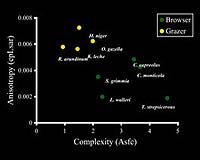
Fayetteville AR (SPX) Nov 21, 2006 University of Arkansas researchers examined the dental landscapes of prehistoric creatures from a South African province and found evidence for a dietary shift that suggests a corresponding change in the type of landscape that surrounded them. This marked change in the prehistoric landscape from woods and shrubs to grasslands may help fill in the picture of environmental changes that accompanied our own evolution. Peter Ungar, professor of anthropology in the J. William Fulbright College of Arts and Sciences, and postdoctoral researchers Gildas Merceron and Rob Scott studied the teeth of bovids, or hoofed mammals, found in the fossil record at Langebaanweg, the site of a unique ecosystem on the coast of South Africa. Ungar reported their findings as part of an address at a symposium last week in Langebaanweg. The region comprises a unique biome - the fynbos biome - home to one of the most diverse groups of plant species in the world with more than 8,700 plant species. "We don't know much about how the fynbos began and whether it relates to human evolution," Ungar said. A crucial time period for human evolution in Africa occurred when grasslands began taking over the forested landscape, possibly forcing human ancestors to change their behavior as well as their diets. Grasslands became increasingly abundant in eastern and perhaps southern Africa from about 5 million years ago. However, little is known about the exact time frame of that shift or its relationship to this area in South Africa, and there are few sites in this region containing fossilized remains that date back to that time period. Langebaanweg does contain fossils that date back to this era, so Ungar and his colleagues decided to examine the issue of landscape change by looking at fossil teeth. "We figured that if we could look at the microwear on these bovids, we could determine what the animals were eating," Ungar said, thus creating a snapshot of the prehistoric landscape. They used a technique that he and colleagues pioneered to examine the microscopic wear on teeth using modified fractal analysis software and a state-of-the-art laser scanning microscope. The pits and grooves in animals' teeth point to different dietary preferences. A pit-laden texture indicates consumption of hard, brittle foods, such as nuts or woody plants. A scratched texture indicates the shearing of food, such as grasses. To look at the diets of prehistoric ungulates, Ungar and his team first looked at the teeth of modern-day hoofed mammals. They observed the diets of browsers, such as duikers and kudu, who eat fruits and nuts from trees, and the diets of grazers, such as oryx and gemsbok, which eat grasses. After determining the eating patterns of these ungulates, the team from the University of Arkansas took impressions of their teeth. Using casts made from the impressions, they looked at the markings on the teeth using the microscope and scale-sensitive fractal analysis software. They found a distinctive difference between the microwear on the teeth of modern-day grazers and browsers. Next, they examined the fossil teeth from ungulates whose remains were discovered in the Western Cape, South Africa, which lived just over 5 million years ago. The data appear to show a shift in the markings on the teeth, indicating a shift in eating patterns from browsing to grazing. "This might indicate the opening up of the grasslands in this area," Ungar said. This is the first time that microwear texture data have suggested a dietary shift within a group of animals before, Ungar said. Community Email This Article Comment On This Article Related Links University of Arkansas, Fayetteville Darwin Today At TerraDaily.com Darwin Today At TerraDaily.com
 Elephants Trample Two Women In Indian Sanctuary
 Dehradun (AFP) India, Nov 20, 2006
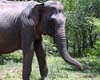
An elephant herd maurading through a state-run northern Indian sanctuary trampled to death two women inside the park on Monday, officials said. "The two women were collecting timber inside Rajaji Park when elephants trampled them to death," said G.S. Pande, director of the 700-square kilometre (270-square mile) sanctuary nestling in the Himalayan foothills. |
|
|

| The content herein, unless otherwise known to be public domain, are Copyright 1995-2006 - SpaceDaily.AFP and UPI Wire Stories are copyright Agence France-Presse and United Press International. ESA PortalReports are copyright European Space Agency. All NASA sourced material is public domain. Additionalcopyrights may apply in whole or part to other bona fide parties. Advertising does not imply endorsement,agreement or approval of any opinions, statements or information provided by SpaceDaily on any Web page published or hosted by SpaceDaily. Privacy Statement |