|
 |
 |
 |
 |
 |
 |
 |
 |

 |
Teenager Moves Video Icons Just By Imagination
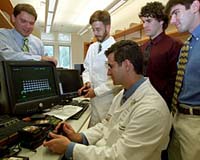
St. Louis MO (SPX) Oct 11, 2006 Teenage boys and computer games go hand-in-hand. Now, a St. Louis-area teenage boy and a computer game have gone hands-off, thanks to a unique experiment conducted by a team of neurosurgeons, neurologists, and engineers at Washington University in St. Louis. The boy, a 14-year-old who suffers from epilepsy, is the first teenager to play a two-dimensional video game, Space Invaders, using only the signals from his brain to make movements. Getting subjects to move objects using only their brains has implications toward someday building biomedical devices that can control artificial limbs, for instance, enabling the disabled to move a prosthetic arm or leg by thinking about it. Many gamers think fondly of Atari's Space Invaders, one of the most popular breakthrough video games of the late '70s. The player controls the motions of a movable laser cannon that moves back and forth across the bottom of the video screen. Row upon row of video aliens march back and forth across the screen, slowly coming down from the top to the bottom of the screen. The objective is to prevent any one of the aliens from landing on the bottom of the screen, which ends the game. The player has an unlimited ammunition supply. The aliens can shoot back at the player, who has to evade, moving left and right. There are lots of levels of play, reflecting the speed at which the aliens descend. The Washington University subject mastered the first two levels of play, using just his imagination. The teenager had a grid atop his brain to record brain surface signals, a brain-machine interface technique that uses electrocorticographic (ECoG) activity - data taken invasively right from the brain surface. It is an alternative to a frequently used technique to study humans called electroencephalographic activity (EEG) - data taken non-invasively by electrodes outside the brain on the scalp. Engineers programmed the Atari software to interface with the brain-machine interface system. Eric C. Leuthardt, M.D., an assistant professor of neurological surgery at the School of Medicine, and Daniel Moran, Ph.D., assistant professor of biomedical engineering, performed their research on the boy who had the grids implanted so that neurologists and neurosurgeons can find the area in the brain serving as the focus for an epileptic seizure, with hopes of removing it to avoid future seizures. To do this, the boy and his doctors, Dr Mathew Smyth and Dr John Zempel, had to wait for a seizure. With approval of the patient and his parents and the Washington University School of Medicine Institutional Review Board, Leuthardt and Moran connected the patient to a sophisticated computer running a special program known as BCI2000 (developed by their collaborator Gerwin Schalk at the Wadsworth Center, New York State Department of Health in Albany) which involves a video game that is linked to the ECoG grid. They then asked the boy to do various motor and speech tasks, moving his hands various ways, talking, and imagining. The team could see from the data which parts of the brain and what brain signals correlate to these movements. They then asked the boy to play a simple, two-dimensional Space Invaders game by actually moving his tongue and hand. He was then asked to imagine the same movements, but not to actually perform them with his hands or tongue. When he saw the cursor in the video game, he then controlled it with his brain. "He cleared out the whole level one basically on brain control," said Leuthardt. "He learned almost instantaneously. We then gave him a more challenging version in two-dimensions and he mastered two levels there playing only with his imagination." In 2004, Leuthardt and Moran led a team who were the first to perform this research on four adult patients. They were anxious to get data from a teenager to see if there are any differences between how teens and adults operate. "It's exciting to be able to look at age differences and see what that tells us about the brain," said Moran, who said the team plans to test more pediatric subjects. "No one has ever seen if brain signals from children are different. We'll try to determine if teenagers have different frequency distributions when their cortex becomes active. We might question if the frequency alterations are different, will that make a difference in performance?" Leuthardt said it is too early to make comparisons between adults and teenagers because they have only one set of teenage data. "But we observed much quicker reaction times in the boy and he had a higher level of detail of control - for instance, he wasn't moving just left and right, but just a little bit left, a little bit right," he said. Graduate students in the Washington University School of Engineering and Applied Science played major roles in the accomplishment. Nick Anderson, a Ph.D. student in biomedical engineering, came up with the idea of using the Space Invaders game to both help the patients pass the time away and garner some very useful, pioneering data. Computer science and engineering master's degree candidate Tim Blakely pulled several all-nighters to program the game into the ECoG system. "Doing this is a win-win situation , both for science and the child," Leuthardt said. "We devised this to be enjoyable and entertaining while we get groundbreaking information on the brain." The clinical team also played a significant role in the planning and orchestration of this research. It was of critical importance that these experiments be safe and not interfere with clinical care. The clinical pediatric portion of the team was led by Mathew Smyth, MD, assistant professor of neurosurgery, and John Zempel, M.D., Ph.D., associate professor of neurology. "This really was a symphony of expertise ranging from neurosurgery, neurology, neuroscience, engineering, and computer science which was years in the making. The end result is something we can really be proud of," Leuthardt said. Community Email This Article Comment On This Article Related Links Washington University in St. Louis Learn about Cyberwar Systems and Policy Issues at SpaceWar.com Space Technology News - Applications and Research
 NASA Finds Cure For Cold Or Hot Feet In Space Or On Earth
 Toms River NJ (SPX) Oct 10, 2006
NASA developed space-age high-tech insulation material used by astronauts now adapted for use by people on earth. Weber's TLC (Temperature Level Control) insoles are very thin (less than 1/8-inch thick) shoe and boot liners. Maintain temperature of soles of wearer's feet at a constant 72-degrees in all kinds of weather, hot or cold. |
|
|

| The content herein, unless otherwise known to be public domain, are Copyright 1995-2006 - SpaceDaily.AFP and UPI Wire Stories are copyright Agence France-Presse and United Press International. ESA PortalReports are copyright European Space Agency. All NASA sourced material is public domain. Additionalcopyrights may apply in whole or part to other bona fide parties. Advertising does not imply endorsement,agreement or approval of any opinions, statements or information provided by SpaceDaily on any Web page published or hosted by SpaceDaily. Privacy Statement |