|
 |
 |
 |
 |
 |
 |
 |
 |

 |
Technology Turns Airline Seat Into Personalized In-Flight Office
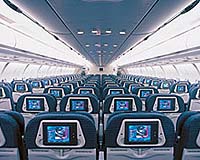
Le Bourget, France (AFP) Jun 19, 2005 Chatting on a cell phone, surfing the Net from a laptop and watching video-on-demand will soon all become part of the standard flying experience, even in economy class, say exhibitors at the weeklong 46th Paris Air Show, which ends Sunday. Technology that transforms airline seats into personalized in-flight offices will be available within months on some airlines, and within a year or two on others, the exhibitors said. There is even a personalized air conditioning system in the pipeline that will allow passengers to breathe fresh air and adjust the temperature around their seat. Swedish mobile phone giant Ericsson developed an airborne version of its cell-phone system within a year following a joint order from a telephone operator and an airline, said Christian Jansson, Ericsson's senior specialist for radio network capacity, adding that he could not yet identify the companies involved. Airplane-compatible cell-phone technology has been around for years, he said, "but now that it is in the mass market, the price of everything has come down. It was simply a matter of making the base station more rugged and shock-resistant." Some passengers may cringe upon learning that the one safe haven from cell-phone chatter - in-flight mobile phone use is still prohibited - may soon disappear. But Jansson points out that the system Ericsson has designed allows flight crews to block calls, during a sleeping period on a long flight, for example, or during take-off and landing. Besides using their cell phones, passengers will be able use back-of-the seat screens to surf the Internet, select video and audio programming on demand, read the in-flight magazine or even a book, shop duty-free, and choose their on-board meals. One system on exhibit, Thales's TopSeries, can be installed on any type of aircraft. It is already available on a number of airlines, and the French company announced during the show that it would supply Air Canada's fleet of 241 aircraft. Tracy Powell, a software consultant for Thales, explains that passengers can either plug into the Internet system, supplied by companies such as Connexion by Boeing, with their own laptop, or they can consult in-flight screens via a built-in control unit. Airlines will typically charge around 30 dollars (25 euros) for an Internet connection, useable at any time during the flight. Powell noted that the main innovation of the system is the video and audio on demand. Rather than making do with pre-scheduled programming, passengers will be able to start a film at any time, and even to put it on hold for a trip to the toilet. Viewing screens are also getting bigger. Those in economy class are 8.9 inches wide (22.6 cm) while those in business or first class are nearly double that at 15 inches (38 cm). Enhanced screen size makes possible other kinds of applications, such as Rockwell Collins "Airshow" software, an interactive map and flight information system. Similar in concept to an interactive website, passengers can click on maps to check not only where the aircraft is at any given moment, but what the points of interest are on the ground - or even under the water - beneath them. Transoceanic flights could provide information on the location of sunken ships and undersea mountain ranges. And if passengers get uncomfortable with the temperature, or because their neighbour has a cold or forgot to use deodorant, Dutch company TNO has come up with a solution: the ventilated seat. Still at the prototype stage, a movable curved headrest supplies humidified, fresh outside air into the breathing zone. There is also a button on the armrest that can vary the temperature above or below the ambient cabin temperature. The system "decreases by a factor of 20 the chances of catching colds and other diseases on an aircraft," said a company spokesman, who asked not to be named. Unlike the mobile phone or in-flight entertainment systems which can be easily set up on existing aircraft, the personalised air-conditioning system could only be installed during a major aircraft overhaul. But the company spokesman says he thinks passengers will start seeing this system "within a couple of years." Community Email This Article Comment On This Article Related Links SpaceDaily Search SpaceDaily Subscribe To SpaceDaily Express Satellite-based Internet technologies
 iPod Dominance A Mirage
 Chicago (UPI) Jan 09, 2006
Though Apple Computer has reported remarkable success with its iPod - sales rose by 250 percent during the last fiscal year - there is some competition coming this week for the developer of the world's most famous, legitimate music downloading network, experts tell United Press International's Networking. |
|
|

| The content herein, unless otherwise known to be public domain, are Copyright 1995-2006 - SpaceDaily.AFP and UPI Wire Stories are copyright Agence France-Presse and United Press International. ESA PortalReports are copyright European Space Agency. All NASA sourced material is public domain. Additionalcopyrights may apply in whole or part to other bona fide parties. Advertising does not imply endorsement,agreement or approval of any opinions, statements or information provided by SpaceDaily on any Web page published or hosted by SpaceDaily. Privacy Statement |