
 |
 |
 |
 |
 |
 |
 |
 |
 |

 |
Technology Enrolled In Hunt For Life On Mars
Chapel Hill NC (SPX) Jun 12, 2008 Scientists looking for evidence of life on Mars have turned to technology invented by University of North Carolina at Chapel Hill researchers to help with their mission. A team from NASA's Jet Propulsion Laboratory in Pasadena, Calif., has created a device for use on the European ExoMars rover mission scheduled for launch in 2013. That space voyage is one of several planned expeditions to the red planet that will follow in the footsteps of NASA's Phoenix mission, which landed on Mars late last month and this week began preparing to test soil samples. The microfluidic or "lab-on-a-chip" device - which takes its name from the fact that the credit-card sized invention can perform multiple detailed laboratory tests - could be used to analyze Martian soil and rock for traces of biological compounds such as amino acids, the building blocks of proteins. But until they turned to materials called perfluoropolyethers (PFPEs), which were first pioneered for use in the field of microfluidics by Joseph DeSimone, Ph.D., Chancellor's Eminent Professor of Chemistry and Chemical Engineering and his colleagues in UNC's College of Arts and Sciences, the NASA team was having trouble making a chip that could withstand the rigors of the proposed mission. Jason Rolland, Ph.D., who helped invent PFPE materials for microfluidic devices when he was a graduate student in DeSimone's lab, said the tiny apparatus handle very small volumes of liquids through tiny channels, and are similar to microelectronic chips, but for fluids. The elastic nature of PFPEs makes it possible to incorporate moving parts such as tiny valves into the devices. In a paper co-written by Rolland and published recently in the Royal Society of Chemistry journal Lab on a Chip, the NASA team, led by Peter Willis, Ph.D., said devices made using PFPE membranes sandwiched between layers of glass were easier to make and greatly outperformed other materials such as PDMS and PTFE, commercially known as Teflon. The chips also held up to severe stress testing, surviving the equivalent of 1 million operations at temperatures ranging from 50 degrees Celsius to minus 50 degrees Celsius virtually unscathed. "It turned out that the material fit right into the sweet spot of what NASA's Jet Propulsion Laboratory needed to enable this device to work," said Rolland, co-founder and director of research and development at Liquidia Technologies, a company which licensed the PFPE technology from UNC. "There are several reasons to suspect that amino acids and other biological molecules could be found on the surface of Mars," Rolland said. "If this device is able to confirm this, it would obviously be one of the most important discoveries of all time. It's exciting to think that UNC and Liquidia Technologies could be a part of that." Community Email This Article Comment On This Article Share This Article With Planet Earth
Related Links University of North Carolina at Chapel Hill Read the study Liquidia Mars News and Information at MarsDaily.com Lunar Dreams and more
 Digging Deep For Martian Life
 Moffett Field CA (ARC) Jul 24, 2007
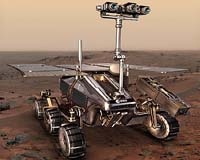
The European Space Agency (ESA), like NASA, has a plan to explore the solar system. ESA's Aurora Programme includes orbiters, landers, rovers, and ultimately, human exploration of the moon and Mars. ExoMars, a rover scheduled to launch in 2011 and to land on Mars in 2013, is one of Aurora's flagship missions. The ExoMars rover will be capable, for the first time since NASA's Viking missions in the 1970s, of searching for direct evidence of martian life. |
|
|

| The content herein, unless otherwise known to be public domain, are Copyright 1995-2007 - SpaceDaily.AFP and UPI Wire Stories are copyright Agence France-Presse and United Press International. ESA Portal Reports are copyright European Space Agency. All NASA sourced material is public domain. Additional copyrights may apply in whole or part to other bona fide parties. Advertising does not imply endorsement,agreement or approval of any opinions, statements or information provided by SpaceDaily on any Web page published or hosted by SpaceDaily. Privacy Statement |
 del.icio.us
 Digg
Digg Reddit
 YahooMyWeb
 Google
 Facebook