|
 |
 |
 |
 |
 |
 |
 |
 |

 |
Technion-CERN Scientists Predict Supernova
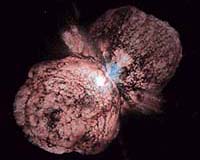
Geneva - Apr 22, 2003 A team of theoretical physicists, Shlomo Dado and Arnon Dar at the Technion, Israel Institute of Technology and Alvaro De Rujula CERN, the European Center for Nuclear Research, in Geneva, Switzerland, has developed a theory to account for the mysterious gamma ray bursts that come from the depths of the Universe. According to their ideas, gamma ray bursts are linked to supernovae, the cataclysmic explosions of massive stars at the end of their lives. When a new gamma ray burst was seen on March 29, 2003, the CERN-Technion team immediately predicted that light from a supernova would first become clearly visible on Earth from the same direction on April 8. And so it did. This is the first time that physicists have predicted the exact day of observation of a supernova. Until now, astronomers could not predict the supernova explosion time to an accuracy better than a million years! Although particle physics and cosmology study opposite extremes -- particle physics is a study of the tiny building blocks of nature, cosmology the large scale workings of the Universe -- the questions they ask are intimately linked. This latest result is a concrete example of the interplay between the two fields. The observational discovery was made on April 8 with the 6.5 meter MMTO and the 6.5 meter Magellan telescope operated by teams from the Harvard Center for Astrophysics in Cambridge, MA, USA and other USA universities. Community Email This Article Comment On This Article Related Links CERN SpaceDaily Search SpaceDaily Subscribe To SpaceDaily Express Stellar Chemistry, The Universe And All Within It
 Sloan Survey Identifies New Dwarf Galaxy Inside Milky Way
 Washington DC (SPX) Jan 10, 2006
Astronomers using the Sloan Digital Sky Survey have discovered a previously unknown cluster of stars within the Milky Way that appears to be a separate dwarf galaxy being consumed by its much larger neighbor. |
|
|

| The content herein, unless otherwise known to be public domain, are Copyright 1995-2006 - SpaceDaily.AFP and UPI Wire Stories are copyright Agence France-Presse and United Press International. ESA PortalReports are copyright European Space Agency. All NASA sourced material is public domain. Additionalcopyrights may apply in whole or part to other bona fide parties. Advertising does not imply endorsement,agreement or approval of any opinions, statements or information provided by SpaceDaily on any Web page published or hosted by SpaceDaily. Privacy Statement |