|
 |
 |
 |
 |
 |
 |
 |
 |

 |
Tech Agreement Paves Way For Globalstar Launch From Baikonur
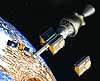
New York - January 28, 1999 - Globalstar announced today that it expects a Soyuz launch of four Globalstar satellites to occur by or before mid-February, following today's signing of the Technology Safeguards Agreement (TSA) by the United States, Russia and Kazakhstan. The TSA is a comprehensive trilateral agreement governing the conditions under which U.S. satellites can be launched from Baikonur. "We're pleased that the TSA is now in place," said Bernard L. Schwartz, chairman and chief executive officer of Globalstar. "This allows us to resume our launch campaign with our first Soyuz launch. Our satellites have been fueled and mated to the dispenser, and the launch readiness review team, which includes outside experts, reports a 'go' condition for the Soyuz-Ikar vehicle. "With the resumption of our schedule, we will launch four satellites roughly every 30 days," Mr. Schwartz continued. "This will result in 32 satellites in orbit by the summer of 1999 and enable a September 1999 start of commercial service. A total of 52 satellites, 48 in operation plus four in-orbit spares, will be in orbit by December 1999. "Our confidence is reinforced by a robust backup plan of launch slots and satellites," Mr. Schwartz said. Globalstar's launch readiness teams have been conducting ground processing work since early January. The teams had been able to fuel and mate the Globalstar satellites to the dispenser, but until the TSA was signed, they were unable to engage in joint operations with the Russian launch teams at Baikonur or begin integration of the dispenser system onto the Russian-built Ikar upper stage. Following the February launch, three more Soyuz launches, each carrying four satellites, will take place through April. These will be followed by a series of three Delta II launches, each carrying four satellites, between May and August, two additional Soyuz launches in September and October, and two more Delta II launches in November and December. To further bolster an already robust launch back-up capability, Globalstar recently awarded a satellite launch contract to Arianespace of Evry, France, for the launch of six Globalstar satellites aboard an Ariane-4 rocket. If the Ariane-4 launch, currently slated for September 1999 from the Guiana Space Center in Kourou, French Guiana, is not required at that time to complete the Globalstar constellation, it will be reassigned by Loral to another mission. Globalstar is the next generation provider of mobile satellite personal communications services. The Globalstar system, comprising 48 low-earth-orbit (LEO) satellites and a global network of ground stations, will provide people around the world with fixed-phone and hand-held mobile satellite phone services, as well as data transmission (at up to 9.6 kilobits per second), messaging, facsimile and position location services. Globalstar is designed to provide cost-effective, high quality mobile satellite services to customers around the world. Its use of advanced CDMA technology ensures superior voice quality, and its system routes calls through multiple satellites simultaneously, minimizing dropped calls and maximizing completed calls. Globalstar has been conducting handset tests since April 1998 via the eight satellites it currently has in orbit, and expects to begin the progressive roll-out of commercial services in the third quarter of 1999. Globalstar now has service provider agreements in more than 100 countries, covering 90 percent of Globalstar's business plan. Five Globalstar gateways are being used to control and test the satellite system, and site work and construction is under way at 20 more gateway sites around the world.
GlobalStar Reports At SpaceDaily
Email This Article Comment On This Article Related Links Space
 Satellite Launch To Boost DTH In India
 Calcutta, India (SPX) Dec 28, 2005
The successful launch Thursday of India's heaviest satellite from spaceport of Kourou in French Guyana may have boosted the country's space research efforts to yet another level, but it has also lifted the spirits of at least three Direct-To-Home televisions broadcasters, one of which has been waiting for years to launch its services in India. |
|
|

|
|
|
|
|
|
|
|
|
|
|
|
| The content herein, unless otherwise known to be public domain, are Copyright 1995-2006 - SpaceDaily.AFP and UPI Wire Stories are copyright Agence France-Presse and United Press International. ESA PortalReports are copyright European Space Agency. All NASA sourced material is public domain. Additionalcopyrights may apply in whole or part to other bona fide parties. Advertising does not imply endorsement,agreement or approval of any opinions, statements or information provided by SpaceDaily on any Web page published or hosted by SpaceDaily. Privacy Statement |