|
 |
 |
 |
 |
 |
 |
 |
 |

 |
Team Me Up, Scotty
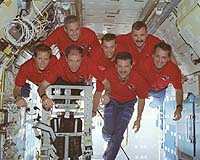
Huntsville AL (SPX) Jan 11, 2005 Weakened bones, radiation-damaged cells, spacecraft malfunctions - when you think of journeying through space, these are the threats that come to mind. Yet, there's another issue equally critical. That issue is teamwork. Astronauts don't travel through space by themselves. They go in pairs or threesomes or even larger groups. Maintaining a successful team in a risky, isolated environment calls for finely honed people-skills. It means that astronauts must develop a keen awareness both of themselves, and of the way they interact with those around them. Of course, astronauts are already people-savvy. They wouldn't be selected as astronauts otherwise. But NASA would like to give them an extra edge, an extra dose of training to help them "team up" exquisitely well. James Carter, a psychologist at Harvard Medical School and Beth Israel Deaconess Medical Center, and Jay Buckey, a doctor and associate professor of medicine at Dartmouth, are heading a NASA project to do just that. They're developing a teamwork training program that can be delivered entirely through a laptop computer - here on the ground or in the distant reaches of space. "If you have a group of people who are very smart about how to work together as a team, that's a group that's going to do well no matter how bad things get," says Buckey, himself an astronaut. "If we can provide the kind of training that gives astronauts that 'extra edge,' then we're opening the door to effective space flight." Their program includes an interactive simulator set onboard a virtual space station akin to the International Space Station (ISS). It allows an astronaut to role-play interpersonal conflicts on the computer. For example, the simulator might present this situation: one crewmember (represented by an actor) accidentally damages a piece of equipment, and asks a crewmate (the role assumed by the astronaut working through the program) for help in concealing the damage. The astronaut decides how to answer the request, and then the program responds, based on that answer. Does an conflict ensue? Will it escalate? "It's a web of options," explains Carter. "You watch a video and then you make a decision. Your choice determines what happens next. You can get through the conflict in as few as three or four decisions, or you can make 10, 15, or even more decisions." There are about 65 video "decision points," with different decisions leading to different resolutions -"from the worst case to the best case scenarios, and everything in between," notes Carter. Astronauts are encouraged to go through the scenarios and experiment with different choices to see how each choice affects the outcome. The program, which is still under development, has not yet been tested to see whether it really does reduce conflict and build stronger teams. Some observers are skeptical that interacting with a computer can teach humans to interact more successfully with other human beings. "We're definitely pushing the envelope," admits Buckey. However, points out Carter, computers have been used successfully to handle some similar problems. They've been used, for example, to treat panic disorders. And other work also augurs the program's success: Research has shown that computers may in some ways exceed the performance of human therapy-providers. "Studies done over the past 30 to 40 years have established," says Carter, "that people are more likely to reveal sensitive information to a computer than to an interviewer." He speculates that some people are simply more comfortable with computers. "They may expect to be judged if they report problems to a human. But a computer doesn't judge." On long-duration space missions, astronauts could run the program in total privacy, however they like, whenever they feel the need. Ease of use and privacy are keys: Often, people are reluctant to ask for help because they don't want to publicize the fact that they need it. They don't attempt to deal with a situation until it has escalated. With a program that's both convenient and private, users will be more likely to get help while problems are still at a less critical- and far more resolvable - stage. Carter and Buckey are continuing to add to the program. In addition to developing more conflict scenarios, they plan to develop an algorithm for treating depression. Other types of content are also possible, such as cultural cross-training - useful for international crews--and stress management. "It's not that there are a lot of these problems occurring," says Carter. Astronauts are well-balanced people with superb skills at handling conflict and managing stress. "Our program is really just to fortify the crew, to give them extra training and make them even more effective as a cohesive unit." According to NASA's new Vision for Space Exploration, astronauts will be going back to the Moon and beyond to Mars. They'll be spending more time farther from Earth than ever before. Extra training is a good thing. Buckey agrees. "Astronauts are professionals, but they're going to be in a tough environment. We're trying to make sure that they're able to deal with that environment in the best way possible." Community Email This Article Comment On This Article Related Links Harvard Medical School Beth Israel Deaconess Medical Center SpaceDaily Search SpaceDaily Subscribe To SpaceDaily Express Space Tourism, Space Transport and Space Exploration News
 Spicing Up Space Meals
 Los Angeles CA (SPX) Jan 04, 2006
Since its launch a year and half ago, Minimus.biz has quickly become the place to go for individual and travel size items. Last week, NASA came to Minimus.biz and purchased several different travel size condiments to send with the astronauts to the International Space Station. |
|
|

| The content herein, unless otherwise known to be public domain, are Copyright 1995-2006 - SpaceDaily.AFP and UPI Wire Stories are copyright Agence France-Presse and United Press International. ESA PortalReports are copyright European Space Agency. All NASA sourced material is public domain. Additionalcopyrights may apply in whole or part to other bona fide parties. Advertising does not imply endorsement,agreement or approval of any opinions, statements or information provided by SpaceDaily on any Web page published or hosted by SpaceDaily. Privacy Statement |