|
 |
 |
 |
 |
 |
 |
 |
 |

 |
Targeting Titan
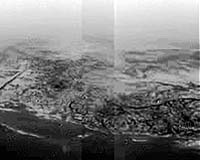
Moffett Field CA (SPX) Jan 19, 2005 University of Hawaii astronomer Toby Owens is one of the original planners of the Cassini-Huygens mission to Saturn and its moon Titan. Astrobiology Magazine's editor Henry Bortman spoke with Owens shortly after the successful Huygens mission had completed. In this part of the interview, Owens talks about the history of the mission and the reasons scientists were interested in exploring Titan. Astrobiology Magazine (AM): How long have you been working on this Cassini-Huygens mission? Toby Owens (TO): From the beginning, 1982. Well, actually we started thinking about it, discussing it, even earlier, right when the Voyager encounter occurred with Titan in 1980. When we saw how interesting it was, a number of us began thinking, Gee, wouldn't it be nice to go back there? Then the opportunity came, on the American side, to plan the next 10 years of NASA missions, and I was made the chairman of the outer planets group, and this was certainly one thing that I was trying to promote. I was very much aware that the Europeans were also interested in this because Daniel Gautier was a good friend of mine and so we were in close communication. And he was in parallel getting ESA interested in this. So we were then able to get both agencies involved. It started with a joint working group. AM: Did it take a lot of convincing in the scientific community to get this idea off the ground, or was everybody pretty enthusiastic about it? TO: There was a lot of enthusiasm for it, because one of our ideas was to make it a big mission. In those days, it was still possible to think in those terms. We realized that the only way to do that was to have both Europe and the United States involved, because neither country by itself, neither organization by itself, would have the finances to do it. We then tried to involve as many different kinds of scientists as we could who would be interested in going to Saturn. And indeed they were. And so we have a full range of scientific activity. You're seeing here with the [Huygens] probe only a small fraction of what the whole program is like. And especially in these days, I'm just delighted that we were able to make such a big mission come together. AM: What was it about Titan that made people want to explore it further? TO: I guess there were a number of things. One was the fact that we couldn't see the surface. And there was a sense of frustration about that. Here's this really big object, bigger than the planet Mercury, and we can't see the surface. We don't know what's down there. And, of course, that gave some impetus to just the sense of exploration. But, more than that, the fact that Titan had this thick atmosphere. And it was an atmosphere dominated by nitrogen, like ours. It's the only other world in the solar system with a thick nitrogen atmosphere. And that in that atmosphere, we saw chemical reactions taking place with fragments of nitrogen and methane coming together, that resembled some of the reactions people have talked about that must have preceded the origin of life on Earth. Saying that, it must be very different on Titan, because it's much colder, you don't have access to the ready supply of oxygen, because of the water. You don't have the liquid water. AM: Do you think it ever had liquid water? TO: There may have been liquid water at isolated instances. In fact there may still be, if you have an impact or some kind of cryo-volcanism (which is like ordinary volcanism, but you have water instead of magma}. And it looks like that kind of thing is happening. We're just beginning to see the indications of that in the data from the spacecraft. So you may still have it. But the main history of Titan has been a low-temperature environment, very low temperature. Community Email This Article Comment On This Article Related Links SpaceDaily Search SpaceDaily Subscribe To SpaceDaily Express Explore The Ring World of Saturn and her moons Jupiter and its Moons The million outer planets of a star called Sol News Flash at Mercury
 Titan: Greenhouse And Anti-Greenhouse
 Moffett Field CA (SPX) Nov 04, 2005
Like Earth, Titan has a greenhouse effect. So does Venus, a whopping one, and so does Mars. Venus is the queen of the greenhouse effect. Ninety-nine point nine percent of the energy reaching the surface of Venus is retained by the greenhouse effect. Titan, though, comes in a close second. |
|
|

| The content herein, unless otherwise known to be public domain, are Copyright 1995-2006 - SpaceDaily.AFP and UPI Wire Stories are copyright Agence France-Presse and United Press International. ESA PortalReports are copyright European Space Agency. All NASA sourced material is public domain. Additionalcopyrights may apply in whole or part to other bona fide parties. Advertising does not imply endorsement,agreement or approval of any opinions, statements or information provided by SpaceDaily on any Web page published or hosted by SpaceDaily. Privacy Statement |