|
 |
 |
 |
 |
 |
 |
 |
 |

 |
Tank And Rocket Chaos Besets Russia Part One
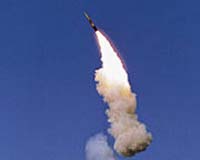
Moscow (UPI) Jan 16, 2007 The Russian defense industry, like any modern institution, plans ahead. Thus four-star Army Gen. Yury Baluyevsky, chief of the General Staff of Russia's armed forces, told a meeting of the Federation Council, the upper house of the Russian Parliament, in mid-November 2007 that "we have already started creating a new program to last until 2020." As a result, this year promises a lot in armaments, both strategic and conventional. At the end of December, Gen. Nikolai Makarov, Russia's chief of armaments and deputy minister of defense, said that the first nuclear submarine armed with the Bulava intercontinental ballistic missile, or ICBM, would join the Russian navy this year. He also said that an entirely new tank would start entering service with the Russian army next year following its tests in 2008. That is all fine if Russia is really going to play a key role in the contradictory and conflicting modern world. However, one fundamental question arises concerning the new armory. Why do we need a new submarine-launched intercontinental ballistic missile and a new tank? Although unpatriotic, this is a far from idle question. Let us pause and think. The Bulava missile -- known as the RSM-56 for use in international treaties and as the SS-NX-30 as NATO's reporting name -- is Russia's latest solid-fuel submarine-launched ballistic missile. It is the product of the Moscow Institute of Heat Engineering, which is also credited with the Topol-M ground-based missile. The theory is that the new missile, when installed on the new Project 995 Borei-class missile submarines, and used in refitting one of the Project 941 Akula boats, will add a new punch to the Russian navy's strike power. This is doubtful. To begin with, the Bulava is a half-baked product. It was first tested in December 2003 and has since had only six firings, four of which failed and during one, which was reported as successful, not all warheads behaved as they should have. To include such a weapon in the regular inventory in 2008, even if there are two further successful launches, given time and funds, is not worthwhile, to put it mildly. In comparison the American Trident-1 intercontinental ballistic missile had 25 flight tests before it entered service, and only three were aborted. Nor does the Bulava's record in any way match the standards of previous Russian missile tests. For example, the RSD-10 Pioneer -- NATO designation SS-20 -- medium-range ballistic missile had 21 launches, all of them successful. No complaint was made when the missile was later used by the troops. The RS-12M Topol -- NATO designation SS-25 -- and the RS-12M2 Topol-M -- NATO designation SS-27 -- each had only one abortive launch out of 13. (Next: Are the new weapons necessary?) (Andrei Kislyakov is a political commentator for RIA Novosti. This article is reprinted by permission of the RIA Novosti news agency. The opinions expressed in this article are the author's and do not necessarily represent those of RIA Novosti.) (United Press International's "Outside View" commentaries are written by outside contributors who specialize in a variety of important issues. The views expressed do not necessarily reflect those of United Press International. In the interests of creating an open forum, original submissions are invited.) Community Email This Article Comment On This Article Related Links The Military Industrial Complex at SpaceWar.com Learn about the Superpowers of the 21st Century at SpaceWar.com
 India Buys T-90s Russian Tanks Part One
 Washington (UPI) Jan 15, 2007
 India's decision last month to purchase a huge new order of 347 Russian T-90 Main Battle Tanks has many profound lessons to teach arms industry analysts and military strategists in the United States and around the world. |
|
|

| The content herein, unless otherwise known to be public domain, are Copyright 1995-2007 - SpaceDaily.AFP and UPI Wire Stories are copyright Agence France-Presse and United Press International. ESA Portal Reports are copyright European Space Agency. All NASA sourced material is public domain. Additional copyrights may apply in whole or part to other bona fide parties. Advertising does not imply endorsement,agreement or approval of any opinions, statements or information provided by SpaceDaily on any Web page published or hosted by SpaceDaily. Privacy Statement |