|
 |
 |
 |
 |
 |
 |
 |
 |

 |
Taking Soil Science to Outer Space
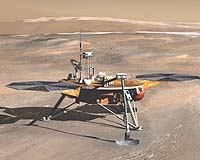
Philadelphia PA (SPX) Jul 17, 2006 The answer to the question about life on Mars may very well come from analyzing an unsuspecting source: Martian soil, specifically the icy layer of soil underneath the red planet's surface. By analyzing the properties of this frozen layer of Martian soil during NASA's next lander mission, scientists will be able to understand and hypothesize more clearly about life on Mars. Douglas R. Cobos, a research scientist and engineer at Decagon Devices in Pullman, Wash., will present a synopsis of the project Monday during the 18th World Congress of Soil Science. NASA is working with Decagon, a soil science equipment manufacturer, on designing a probe to take soil and atmospheric measurements during the Phoenix Lander mission. By exposing this frozen soil layer to the Sun, researchers hope to measure the properties of the liquid water before it turns to a vapor. Cobos said the discovery of liquid water would be a "big finding and best-case scenario for the Mars research community." Liquid water - the presumed pre-cursor for life - could even point to "life in a dormant state on Mars," he added. Cobos said the physics on Mars is such that ice tends to go directly from the solid form into a vapor. "If we can measure this liquid water using our specialized sensor mounted on the robotic arm of the lander, we'll be able to turn over the data to the planetary scientists to analyze the climate and conditions on Mars," Cobos said. The scientists then would use the data to determine if life ever arose on Mars or if it could sustain life in the future. "We're waiting to see what's up there," he said. "The best-case scenario would be to dig, probe around and finally have conclusive proof that there can be liquid water on Mars. It's pretty exciting to actually have our sensor bolted to the arm of the lander." Cobos, who has been working on the lander's sensor for two years, just returned from NASA's Jet Propulsion Laboratory in Pasadena, Calif., where he and mission engineers mounted the sensor to the arm of the lander and calibrated it. The Phoenix mission is scheduled to lift off in late 2007, the lander is planned to arrive on Mars to begin its discoveries in early 2008. Community Email This Article Comment On This Article Related Links 18th World Congress of Soil Science Life Beyond Earth Lands Beyond Beyond - extra solar planets - news and science
 Must Ecologists Account For Time To Understand Biodiversity In Space
 Chapel Hill NC (SPX) Jun 27, 2006
Ecologists typically study biodiversity in "snapshots" - single-time surveys conducted in many locations - and try to understand why some habitats have more species than others, or why larger areas contain more species than smaller ones. But what are ecologists missing if they ignore the reality that communities are not snapshots but continually in flux? |
|
|

| The content herein, unless otherwise known to be public domain, are Copyright 1995-2006 - SpaceDaily.AFP and UPI Wire Stories are copyright Agence France-Presse and United Press International. ESA PortalReports are copyright European Space Agency. All NASA sourced material is public domain. Additionalcopyrights may apply in whole or part to other bona fide parties. Advertising does not imply endorsement,agreement or approval of any opinions, statements or information provided by SpaceDaily on any Web page published or hosted by SpaceDaily. Privacy Statement |