|
 |
 |
 |
 |
 |
 |
 |
 |

 |
Taiwan plans to produce supersonic anti-ship missiles: report
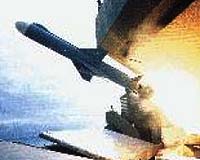
Taipei (AFP) May 17, 2006 Taiwan plans to make 130 supersonic anti-ship missiles beginning next year to counter rival China's continued naval buildup, a newspaper and military expert said Wednesday. The defense ministry has drafted the five-year project called "Chui Feng" (Pursuing Wind) and plans to submit it to parliament for approval later this year, the Liberty Times said. The Hsiung Feng III missiles, designed to cruise at a maximum speed of mach 2.0 with a range of up to 130 kilometers (78 miles), would be installed on frigates and patrol boats, it said. Developed by the military-run Chungshan Institute of Science and Technology, the missiles would be used to fend off Chinese attacks supposed to be launched from the Varyag -- a stripped-down former Soviet aircraft carrier bought by China -- should war break out in the Taiwan Strait, the paper said. Taiwan would become the third country in Asia to be armed with supersonic anti-ship missiles, the paper said. According to a previous report in Jane's Defense Weekly, the Hsiung Feng III can be fitted with a variety of guidance systems and function as an anti-ship, land-attack or anti-radar missile. The defense ministry declined to comment on the newspaper report. A military expert said Taiwan had been working on the missile project but while China had plans to operate an aircraft carrier, the ageing Varyag was unlikely to meet its demands. The "condition of Varyag is horrible. It could only be used for training and study purposes," Wendell Minnick, Asia Bureau chief of the US-based Defense News weekly, told AFP. "They will have to build a new one on their own as they attempt to operate a project force which can strike targets beyond their territory," he said. It was not clear when China would commission its first carrier, but Minnick said it was not likely to be anytime soon. "In the United States, building an aircraft carrier may take five to 10 years... but China lacks such experience. It may even longer," he said. China has repeatedly threatened to invade Taiwan should it move towards formal independence, prompting the island to seek more advanced weaponry. Beijing announced in March its military budget for this year would rise 14.7 percent to 35 billion US dollars. A Pentagon report last year estimated that China's defense spending was two to three times the publicly announced figure and that the cross-strait military balance was tipping in Beijing's favor. Community Email This Article Comment On This Article Related Links Learn about missile defense at SpaceWar.com All about missiles at SpaceWar.com
 LM Completes Missile-Warning System Software Development
 Denver CO (SPX) May 17, 2006
Lockheed Martin announced Tuesday it has completed Highly Elliptical Orbit Interim Operations software for the U.S. military's Space Based Infrared System. The software is considered an important component for SBIRS HEO payloads and geosynchronous satellites, the company said in a statement. |
|
|

| The content herein, unless otherwise known to be public domain, are Copyright 1995-2006 - SpaceDaily.AFP and UPI Wire Stories are copyright Agence France-Presse and United Press International. ESA PortalReports are copyright European Space Agency. All NASA sourced material is public domain. Additionalcopyrights may apply in whole or part to other bona fide parties. Advertising does not imply endorsement,agreement or approval of any opinions, statements or information provided by SpaceDaily on any Web page published or hosted by SpaceDaily. Privacy Statement |