|
 |
 |
 |
 |
 |
 |
 |
 |

 |
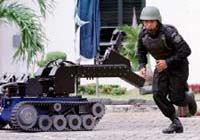
TALON Robot Detects Chemicals, Gases, Radiation and Heat
Waltham MA (SPX) Sep 28, 2004 Foster-Miller announced today that its newest TALON robots are equipped with off-the-shelf chemical, gas, temperature, and radiation sensors that can be read simultaneously, remotely and in real time via one integrated hand-held display unit invented by Foster-Miller. TALON robots are the only robots on the market that now offer this crucial sensing capability to civilian first- responders and the military.
The APD 2000 detects chemical warfare agents, gamma radiation and irritants such as pepper spray and mace. The Draeger Multiwarn II can measure more than 50 gases including carbon dioxide, methane, propane, fuels and solvents. The Raytek Raynger MX4+ is the most advanced portable thermometer in the industry and the only one designed with precise infrared beam tracking. It is accurate to within 1 deg C and can be used to remotely sense the heat of a fire behind a closed door. The Thermo FH40GL takes measurements between 30 kilo-electron-volts and 1.3 mega-electron-volts and can record a radiological exposure rate from 1 micro-Roentgen per hour to 10 Roentgens per hour. Foster-Miller integrated the four sensors into one hand-held PDA (personal digital assistant) so that robot operators can send TALON to check an area for the presence of chemicals, radiation, gases or fires before personnel enter. Other off-the-shelf sensor brands and options will also be offered on future TALON robots, including BAE Systems' Chem Sentry 150 C, Rae Systems' Neutron RAE and Canberra's AN/VDR. The first sensor-suite robot is ready to be delivered to the U.S. Army's Armament Research, Development and Engineering Center (ARDEC) Fire Department, Picatinny, NJ. It is on display this week in the Foster-Miller booth at the "Technologies for Public Safety in Critical Incident Response Conference and Exhibition" being held at the Hyatt Regency New Orleans through Sept. 29. "Foster-Miller is proud to be able to further assist and protect first responders, bomb squads and military EOD units as they carry out their life- saving work," said Dr. William Ribich, president of Foster-Miller. "This enhanced detection capability joins a long list of tasks that can be performed by our versatile and reliable TALON robots." Workhorse of Iraq and Afghanistan, Foster-Miller's TALON robots have already performed over 10,000 explosive ordnance disposal (EOD) missions. They are rugged, all-weather platforms capable of maneuvering in desert or beach sand, snow, water, grassy or wooded terrain, and inside buildings. TALON robots can climb stairs and sustain falls and right themselves. They have been lowered into landing zones by helicopters, dropped from moving vehicles and launched offshore to reach underwater targets. They were the only US-made robots successfully used at the World Trade Center in the aftermath of September 11. Community Email This Article Comment On This Article Related Links Foster-Miller, Inc. SpaceDaily Search SpaceDaily Subscribe To SpaceDaily Express All about the robots on Earth and beyond!
 Engineers Deliver Robot to Neutralize Remote Explosives
 Tyndall AFB (SPX) Jun 30, 2005
Engineers from the Air Force Research Laboratory Materials and Manufacturing Directorate have rapidly prototyped, developed, and delivered low-cost expendable robots to disable and dispose of improvised explosive devices. |
|
|

| The content herein, unless otherwise known to be public domain, are Copyright 1995-2006 - SpaceDaily.AFP and UPI Wire Stories are copyright Agence France-Presse and United Press International. ESA PortalReports are copyright European Space Agency. All NASA sourced material is public domain. Additionalcopyrights may apply in whole or part to other bona fide parties. Advertising does not imply endorsement,agreement or approval of any opinions, statements or information provided by SpaceDaily on any Web page published or hosted by SpaceDaily. Privacy Statement |