
 |
 |
 |
 |
 |
 |
 |
 |
 |

 |
Swords and Shields: Piracy war doctrine
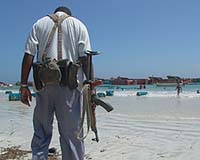
Washington (UPI) Oct 9, 2008 Those who cheer the decline of the United States as the pre-eminent global power should note the rise in Somali-based piracy with anxiety. The ghost of Thomas Hobbes, the 17th century English political philosopher, is staring them in the face. This is the essential Hobbesian dilemma: While many governments in the developing world are corrupt and inefficient, the total absence of government, which breeds chaos and the war of all against all, is even worse. The weakening of a dominant naval power, such as the British Empire and the United States were for the last 400 years, may severely disrupt global trade and shipping, increase military expenses, including allocation for the green and brown water navies, and bring misery to both developed and developing economies. Somalia is a victim of 14 failed attempts at establishing a government since the overthrow of its military rulers in 1991. Somalia today is the heart of darkness. The fundamental reason for the development of a full-fledged piracy industry in Somalia is the lack of a central government and ensuing lawlessness. Whole fishing villages are resorting to piracy. And what happened there can happen elsewhere, if the great powers do not cooperate and roll back the outlaws. Yet the international community has been unwilling to intervene heavily in Somalia, and groups opposing the government often interfere with or steal from what aid efforts do occur. The short-term solution is to proactively destroy the current pirate gangs, their bases and vessels by force. But a long-term solution would have to involve strengthening the Somali government so it can police its own territorial waters and enforce anti-piracy laws. A major hub of pirate activity is the Somali town of Eyl, where the embattled Ethiopian military, the African Union and the U.N.-supported government have no control. Iran and Saudi Arabia are supporting the Islamist Court Committees, which are battling the government. The Islamist group al-Shabaab, which is also fundamentalist, is employing piracy as a strategy. Pirate groups generally are well organized and well equipped with speedboats and rocket-propelled grenades. Today, the U.N. Security Council supports the anti-piracy action and the Somali government granted permission for foreign naval forces to enter its territorial waters in pursuit of pirates or to defend a threatened vessel. The U.S. Navy's 5th Fleet has deployed additional naval assets to the region, the Russian government has dispatched a warship ostensibly for anti-piracy duties, and the European Union has begun discussing the possibility of dispatching a larger naval mission. An aggressive and long-term naval commitment to this goal can destroy and then deter the pirates. The doctrine for such operations should reach beyond interception and destruction of the pirate vessels and include well-prepared helicopter-borne commando raids on the pirate land bases; destruction of their "mother ships"; recruitment among the pirates of human intelligence assets with the ability to identify and communicate in real time the gang leaders' locations; and decapitation strikes against these gang chieftains. (Ariel Cohen, Ph.D., is senior research fellow for International Energy Security at the Heritage Foundation and author of "Kazakhstan: The Road to Independence," 2008.) Community Email This Article Comment On This Article Share This Article With Planet Earth
Related Links 21st Century Pirates
 NATO to send ships within two weeks to combat Somalia pirates
 Budapest (AFP) Oct 9, 2008
NATO defence ministers agreed Thursday to send seven war ships this month to help combat piracy off Somalia, as attacks on vessels in Horn of Africa waters spiral, an alliance spokesman said. |
|
|

| The content herein, unless otherwise known to be public domain, are Copyright 1995-2007 - SpaceDaily.AFP and UPI Wire Stories are copyright Agence France-Presse and United Press International. ESA Portal Reports are copyright European Space Agency. All NASA sourced material is public domain. Additional copyrights may apply in whole or part to other bona fide parties. Advertising does not imply endorsement,agreement or approval of any opinions, statements or information provided by SpaceDaily on any Web page published or hosted by SpaceDaily. Privacy Statement |
 del.icio.us
 Digg
Digg Reddit
 YahooMyWeb
 Google
 Facebook