|
 |
 |
 |
 |
 |
 |
 |
 |

 |
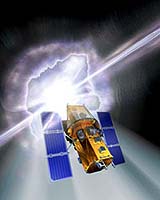
Swift Spies Unusual Bang In Far Universe
Leicester, UK (SPX) Apr 07, 2006 In the nearly 40 years since high-energy gamma-ray bursts in space were first discovered by U.S. satellites looking for Soviet nuclear detonations on Earth, many thousands of the strange phenomena have been observed, but scientists still do not understand them well - and a recent example might cause further confusion instead of improved understanding. Last Aug. 1, instruments on board the NASA-UK-Italy Swift spacecraft detected a bizarre gamma-ray burst, or GRB, which displayed what astronomers called "unprecedented behavior." Conventional deep-space gamma-ray bursts, such as they are, produce brilliant radiation - for a few seconds outshining entire galaxies in the gamma-ray, X-ray and even optical ranges of the spectrum. The brightness usually is followed by a slowly fading afterglow, usually lasting for several days. Since Swift began observing in November 2004, its data have shown that whatever the central engine that powers GRBs may be, it does not switch off after a few seconds, but often produces fast flares of radiation and injects energy into the outflow for hours. Scientists suspect most GRBs are the result of black holes swallowing massive stars. This process might explain both the prompt emission of X-rays and gamma rays - at the moment of collision - and the lingering flares and energy injection. The hypothesis is the energy from the collision launches the remaining matter from the star outward at great velocity, but the interstellar medium around the burst acts like a brake on the outflow, and is heated in the process to produce the afterglow. The August 2005 burst, named GRB050801 after its date of detection, produced a bright afterglow and a steady emission both in X-ray and optical wavelengths - but no initial brilliant flare. Moreover, the behavior lasted only 250 seconds after the end of the prompt emission, before the afterglow began the typical decline in brightness. This behavior has never been observed before. The flat emission in both X-ray and optical wavelengths could provide some hints about the GRB's central engine, scientists said. "This feature might be explained if we assume that, rather than a black hole, the core of the star has shrunk its mass and its magnetic field into an object known as a magnetar," said Massimiliano De Pasquale of the University College of London's Mullard Space Science Laboratory. A magnetar is a form of neutron star, the remains of a collapsed star that originally was about 10 times more massive than the Sun. Such an extremely dense object typically has a radius of only 10 kilometers (6.2 miles) but the same mass as the Sun. Magnetars are thousands of times more magnetic than ordinary neutron stars, with a magnetic field 1,000 trillion times stronger than Earth's. Scientists know of only a few of the exotic objects. "Such an object initially rotates very quickly, typically hundreds of times every second, but it slows down by irradiating its energy at the magnetic poles, like a lighthouse," De Pasquale explained. "This would keep the afterglow emission steady for a time scale similar to that observed for GRB050801." Reporting at a meeting of the Royal Astronomical Society, De Pasquale said analyses of the Swift data has allowed his team to determine the distance of GRB050801 - which previously was unknown - by measuring the amount of light absorbed during its intergalactic travel en route to the spacecraft. It turns out the burst took place 9 billion light-years away, which means all of the gamma rays, X-rays and light were created and began their journey across the universe 4.5-billion years before Earth was even born. "The explosion produced the same amount of energy as the Sun (will produce) during its entire lifetime of 10 billion years," De Pasquale said. Community Email This Article Comment On This Article Related Links Swift Stellar Chemistry, The Universe And All Within It
 Survey Reveals Building Block Process For Biggest Galaxies
 Leicester England (SPX) Apr 07, 2006
A new study of the universe's most massive galaxy clusters shows how mergers play a critical role in their evolution. Astronomers used the twin Gemini Observatory instruments in Hawaii and Chile, and the Hubble Space Telescope to study populations of stars in the universe's most massive galaxy clusters over a range of epochs - the earliest being nearly 7 billion years old, or half the age of the universe. |
|
|

| The content herein, unless otherwise known to be public domain, are Copyright 1995-2006 - SpaceDaily.AFP and UPI Wire Stories are copyright Agence France-Presse and United Press International. ESA PortalReports are copyright European Space Agency. All NASA sourced material is public domain. Additionalcopyrights may apply in whole or part to other bona fide parties. Advertising does not imply endorsement,agreement or approval of any opinions, statements or information provided by SpaceDaily on any Web page published or hosted by SpaceDaily. Privacy Statement |