|
 |
 |
 |
 |
 |
 |
 |
 |

 |
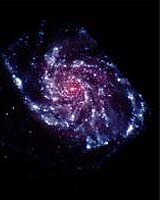
Swift Sees Pinwheel Galaxy, Satellite Fully Operational
Greenbelt MD (SPX) Feb 02, 2005 The Swift satellite's Ultraviolet/Optical Telescope (UVOT) has seen first light, capturing an image of the Pinwheel Galaxy, long loved by amateur astronomers as the "perfect" face-on spiral galaxy. The UVOT now remains poised to observe its first gamma-ray burst and the Swift observatory, launched into Earth orbit in November 2004, is now fully operational. Swift is a NASA-led mission dedicated to the gamma-ray burst mystery. These random and fleeting explosions likely signal the birth of black holes. With the UVOT turned on, Swift now is fully operational. Swift's two other instruments - the Burst Alert Telescope (BAT) and the X-ray Telescope (XRT) - were turned on over the past several weeks and have been snapping up gamma-ray bursts ever since. "After many years of effort building the UVOT, it was exciting to point it toward the famous Pinwheel Galaxy, M101," said Peter Roming, UVOT Lead Scientist at Penn State. "The ultraviolet wavelengths in particular reveal regions of star formation in the galaxy's wispy spiral arms. But more than a pretty image, this first-light observation is a test of the UVOT's capabilities." Swift's three telescopes work in unison. The BAT detects gamma-ray bursts and autonomously turns the satellite in seconds to bring the burst within view of the XRT and the UVOT, which provide detailed follow-up observations of the burst afterglow. Although the burst itself is gone within seconds, scientists can study the afterglow for clues about the origin and nature of the burst, much like detectives at a crime scene. The UVOT serves several important functions. First, it will pinpoint the gamma-ray burst location a few minutes after the BAT detection. The XRT provides a burst position within a 1- to-2-arcsecond range. The UVOT will provide sub-arcsecond precision, a spot on the sky far smaller than the eye of a needle at arm's length. This information is then relayed to scientists at observatories around the world so that they can view the afterglow with other telescopes. As the name applies, the UVOT captures the optical and ultraviolet component of the fading burst afterglow. "The 'big gun' optical observatories such as Hubble, Keck, and VLT have provided useful data over the years, but only for the later portion of the afterglow," said Keith Mason, the U.K. UVOT Lead at University College London�s Mullard Space Science Laboratory. "The UVOT isn't as powerful as these observatories, but has the advantage of observing from the very dark skies of space. Moreover, it will start observing the burst afterglow within minutes, as opposed to the day-long or week-long lag times inherent with heavily used observatories. The bulk of the afterglow fades within hours." The ultraviolet portion will be particularly revealing, said Roming. "We know nearly nothing about the ultraviolet part of a gamma-ray burst afterglow," he said. "This is because the atmosphere blocks most ultraviolet rays from reaching telescopes on Earth, and there have been few ultraviolet telescopes in orbit. We simply haven't yet reached a burst fast enough with a UV telescope." The UVOT's imaging capability will enable scientists to understand the shape of the afterglow as it evolves and fades. The telescope's spectral capability will enable detailed analysis of the dynamics of the afterglow, such as the temperature, velocity, and direction of material ejected in the explosion. The UVOT also will help scientists determine the distance to the closer gamma-ray bursts, within a redshift of 4, which corresponds to a distance of about 11 billion light years. The XRT will determine distances to more distant bursts. Scientists hope to use the UVOT and XRT to observe the afterglow of short bursts, less than two seconds long. Such afterglows have not yet been seen; it is not clear if they fade fast or simply don't exist. Some scientists think there are at least two kinds of gamma-ray bursts: longer ones (more than two seconds) that generate afterglows and that seem to be caused by massive star explosions, and shorter ones that may be caused by mergers of black holes or neutron stars. The UVOT and XRT will help to rule out various theories and scenarios. The UVOT is a 30-centimeter telescope with intensified CCD detectors and is similar to an instrument on the European Space Agency's XMM-Newton mission. The UVOT is as sensitive as a four-meter optical ground-based telescope. The UVOT's day-to-day observations, however, will look nothing like M101. Distant and faint gamma-ray burst afterglows will appear as tiny smudges of light even to the powerful UVOT. The UVOT is a joint product of Penn State and the Mullard Space Science Laboratory. Community Email This Article Comment On This Article Related Links SpaceDaily Search SpaceDaily Subscribe To SpaceDaily Express Space Telescope News and Technology at Skynightly.com
 Cornell's Contract For Management Of Arecibo Observatory Renewed
 Ithaca NY (SPX) Apr 06, 2005
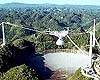
The National Science Foundation (NSF) has renewed Cornell University's management contract for the operation of Arecibo Observatory, the world's largest and most-sensitive single-dish radio/radar telescope.
--------------------------------------------------------- It's new. And it's downright terrific! Celestron's CPC Schmidt-Cassegrain telescope is the scope you've been waiting for! It offers new alignment technology, advanced engineering, and bold new design at a new, low price! In fact, Celestron's Professional Computerized (CPC) scope with revolutionary SkyAlign Alignment Technology redefines everything that amateur astronomers are looking for. It offers quick and simple alignment, GPS technology, unsurpassed optical quality, ease of use, advanced ergonomics, enhanced computerization and, most important, affordability. Want to view M-31 tonight? One button takes you there!
Shop for telescopes online at Telescopes.com! today!
|
|
|

| The content herein, unless otherwise known to be public domain, are Copyright 1995-2006 - SpaceDaily.AFP and UPI Wire Stories are copyright Agence France-Presse and United Press International. ESA PortalReports are copyright European Space Agency. All NASA sourced material is public domain. Additionalcopyrights may apply in whole or part to other bona fide parties. Advertising does not imply endorsement,agreement or approval of any opinions, statements or information provided by SpaceDaily on any Web page published or hosted by SpaceDaily. Privacy Statement |