
 |
 |
 |
 |
 |
 |
 |
 |
 |

 |
Swerve Left To Avoid That Satellite
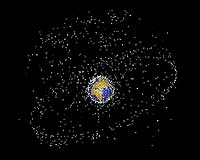
Tel Aviv, Israel (SPX) Jul 11, 2008 Think you have trouble getting rid of the clutter in your living room? After more than 50 years of launching rockets and satellites into space, the human race now has to deal with the clutter left behind -- or is it "above"? Dead satellites, spent rocket stages, paint flakes, and coolant from nuclear-powered satellites continue to orbit the Earth at ultrahigh velocities. It's a serious subject. Space debris threatens the lives of astronauts and the launch of new satellites today, says Dr. Noam Eliaz, Head of the Biomaterials and Corrosion Laboratory at the School of Mechanical Engineering at Tel Aviv University. An expert in materials science and engineering, Dr. Eliaz is working with a team at Soreq NRC to create and test new materials to make the heavens safer for satellites and astronauts alike.
The Hazards in Space Eliaz says that the combined effects of other components in the space environment, such as atomic oxygen, might increase the damage. The researcher, a past Fulbright and Rothschild scholar at MIT, is investigating new kinds of materials that could be used on spacecraft surfaces to protect against such hazards.
Finding an Answer in Materials Science One candidate Eliaz and his colleagues have investigated is a hybrid nanomaterial which incorporates small silicon-containing cages that can open and react with atomic oxygen to prevent further polymer degradation. The team includes Dr. Eitan Grossman, Head of the Materials Group within the Space Environment Section at Soreq NRC in Israel, and his staff Dr. Irina Gouzman and Ronen Verker, the latter also a Ph.D. student at TAU. Recent research by Eliaz and his colleagues at Soreq has been published in the journals Acta Materialia, Polymer and High Performance Polymers.
The American Connection "Our simulation studies were done on Earth to determine how space debris will impact new polymers developed to protect space vehicles," says Dr. Eliaz. The U.S. Department of Defense recently asked Dr. Eliaz to advise them on alternatives to hard chromium plating. Now used in aircraft landing gears, chromium VI is a carcinogen, causing agencies to limit or prohibit its use. Eliaz's research belongs to a growing field known as materials science and engineering. "This is an important area for all aspects of industry, and Tel Aviv University is a trendsetter in this field," says Eliaz. Many global companies, including GE, Intel, Motorola, Applied Materials, General Motors and IBM, have R and D centres dealing with materials development, processing and characterization, and often look to Tel Aviv University researchers or advice. Community Email This Article Comment On This Article Share This Article With Planet Earth
Related Links Tel Aviv University Space Technology News - Applications and Research
 US, China Space Debris Still Orbiting Earth
 Beijing, China (XNA) May 20, 2008
Debris from the U.S. intercept of a spy satellite in February and from China's anti-satellite test in Janaury 2007 is still orbiting Earth, according to a space debris expert. |
|
|

| The content herein, unless otherwise known to be public domain, are Copyright 1995-2007 - SpaceDaily.AFP and UPI Wire Stories are copyright Agence France-Presse and United Press International. ESA Portal Reports are copyright European Space Agency. All NASA sourced material is public domain. Additional copyrights may apply in whole or part to other bona fide parties. Advertising does not imply endorsement,agreement or approval of any opinions, statements or information provided by SpaceDaily on any Web page published or hosted by SpaceDaily. Privacy Statement |
 del.icio.us
 Digg
Digg Reddit
 YahooMyWeb
 Google
 Facebook