|
 |
 |
 |
 |
 |
 |
 |
 |

 |
SwRI Ultraviolet Spectrometer Aboard Rosetta Performing Flawlessly
San Antonio (SPX) May 13, 2004 The Alice ultraviolet imaging spectrometer, one of three NASA instruments aboard the European Space Agency (ESA) Rosetta comet orbiter, successfully passed its space checkout last month. The checkout occurred approximately 20 million kilometers from Earth under radio command and control, leading to textbook "first light" observations of the interplanetary hydrogen and a nearby, bright comet called C/2002 T7 (LINEAR). "Rosetta's launch was bang on the mark, and the spacecraft is well on its way to its target comet. During this journey, Rosetta will also explore the atmosphere of Mars during a flyby in 2007 and two asteroids in later years," says Dr. Alan Stern, Alice principal investigator and director of the Space Studies Department at Southwest Research Institute. "When Rosetta encounters Churyumov-Gerasimenko, the ancient comet it is targeted to orbit in 2014, the NASA-SwRI Alice instrument will become the first ultraviolet spectrometer to ever reach a comet." "Alice will spend hundreds of days in cometary orbit, analyzing the composition of Churyumov-Gerasimenko's atmosphere, mapping its surface and studying the properties of fine dust particles coming off the comet," Stern says. "This investigation will provide an unprecedented window into both the origin of comets and the way comets work." "Alice is a highly miniaturized spectrometer with more than 1,000 times the data-gathering capability of instruments flown a generation ago, and a sensitivity for atmospheric measurements comparable to the Hubble Space Telescope -- yet it weighs less than 4 kg and draws just 3 watts of power," explains Alice Project Manager John Scherrer, also of SwRI. "The successful turn on and checkout of Alice in space represents a major milestone in the US Rosetta program." Alice Operations Scientist and SwRI Manager Dr. Joel Parker continues, "We really couldn't have expected a healthier instrument than we have. All subsystems are performing nominally, and every indication we have is that the instrument's scientific performance is on spec." Alice was built and is operated by SwRI for NASA. The instrument is designed to probe the atmosphere and surface of Churyumov-Gerasimenko. A sister Alice instrument is also set to launch aboard the New Horizons mission to Pluto in January 2006 for studies of that distant world's atmosphere. SwRI also built and will operate the Ion and Electron Spectrometer (IES) flying aboard Rosetta. Principal Investigator Dr. James Burch, vice president of the SwRI Space Science and Engineering Division, leads IES operations. Despite its mass of just 1.04 kilograms, laboratory tests showed the spectrometer achieves sensitivity comparable to other instruments weighing five times more. IES will simultaneously measure the flux of electrons and ions surrounding the comet over an energy range extending from the lower limits of detectability, near 1 electron volt, up to 22,000 electron volts. It uses a novel, electrostatic scanning technique to view particles from directions encompassing 70 percent of the celestial sphere. Although not yet fully operational, preliminary tests of IES show it too is operating nominally. Community Email This Article Comment On This Article Related Links Rosetta at ESA Alice instrument New Horizons SpaceDaily Search SpaceDaily Subscribe To SpaceDaily Express Asteroid and Comet Mission News, Science and Technology
 Stardust Entry Path To Be Visible In Northwest
 Pasadena CA (JPL) Jan 10, 2006
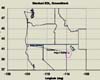
On January 15, 2006, after more than 7 years and billions of miles of travel through space, NASA's Stardust spacecraft will release a 100-pound sample return capsule (SRC) to Earth with some precious cargo - pristine samples of comet and interstellar dust. |
|
|

| The content herein, unless otherwise known to be public domain, are Copyright 1995-2006 - SpaceDaily.AFP and UPI Wire Stories are copyright Agence France-Presse and United Press International. ESA PortalReports are copyright European Space Agency. All NASA sourced material is public domain. Additionalcopyrights may apply in whole or part to other bona fide parties. Advertising does not imply endorsement,agreement or approval of any opinions, statements or information provided by SpaceDaily on any Web page published or hosted by SpaceDaily. Privacy Statement |