|
 |
 |
 |
 |
 |
 |
 |
 |

 |
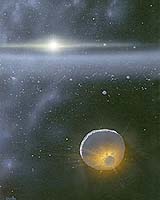
SwRI Researchers Show Planetoid Sedna May Have Formed Far Beyond Pluto
Boulder CO (SPX) Jan 12, 2005 Recently, astronomers reported the surprising discovery of a very large diameter Kuiper Belt planetoid - (90377) Sedna - on a distant, 12,500-year-long, eccentric orbit centered approximately 500 astronomical units from the Sun. Sedna's estimated diameter is about 1,600 km, two-thirds that of Pluto. Initial studies of Sedna's origin have speculated that it might have been ejected from the giant planets region of our solar system far inside the orbit of Pluto, or perhaps was captured from a passing star's Kuiper Belt. In a report published in the January 2005 issue of The Astronomical Journal, planetary scientist Dr. Alan Stern of the Space Science and Engineering Division at Southwest Research Institute (SwRI) shows Sedna could have formed far beyond the distance of Pluto. "If this is actually what happened," Stern points out, "it would indicate that our solar system's planet factory operated across a much larger region than previously thought." It would also indicate that the mysterious Kuiper Belt "edge" near 50 AU (one AU is the distance from the Earth to the Sun) is not an outer edge, but simply the inner edge of an annular trough, or gap, that is carved out of a much broader structure that has been called the "Kuiper disk." The new Sedna formation study used a planetary accretion code developed by Stern with funding from NASA's Origins of Solar System's Program in the late 1990s for studies of the formation of Kuiper Belt Objects. This software was used to explore the feasibility of building Sedna from boulder-sized and other small bodies at distances between 75 AU (Sedna's closest solar approach distance) and 500 AU (Sedna's average distance from the Sun). Stern's Sedna formation simulations assumed that Sedna's original orbit, while distant from the Sun, was circular. Astronomers agree that Sedna could not have formed in its present, eccentric orbit because such an orbit allows only violent collisions that prevent the growth of small bodies. Stern's simulations further assumed that the solar nebula - the disk of material out of which the planets formed - was much more extended than most previous simulations had assumed. "The Sedna formation simulations assumed that the primordial solar nebula was a disk about the size of those observed around many nearby middle-aged stars - like the well-known example of the 1,500-AU-wide disk around the star Beta Pictoris," Stern says. "The model calculations found that objects as large, or even larger, than Sedna could easily form in circular orbits at distances of 75 to 500 AU, and that their formation time could have been fairly short - just a few percent the age of the solar system," Stern continues. "If Sedna did form this far out, it is likely to be accompanied by a cohort of other large planetoids in this very distant region of the solar system. One telltale sign that these objects were formed where they are, rather than in another location, would be if a good fraction of them are on near circular orbits." Community Email This Article Comment On This Article Related Links SwRI SpaceDaily Search SpaceDaily Subscribe To SpaceDaily Express The million outer planets of a star called Sol
 New Horizons Remains On Course For January 17 Launch To Pluto
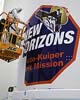 Boulder CO (SPX) Jan 09, 2006
The past two weeks have been pretty quite for our intrepid spacecraft. For the most part, she has slept, un-powered, while launch vehicle and ground system preparations have continued. About the only real action came on January 3rd, when the final flight parameter loads were installed in the twinned computers New Horizons carries within her hull. |
|
|

| The content herein, unless otherwise known to be public domain, are Copyright 1995-2006 - SpaceDaily.AFP and UPI Wire Stories are copyright Agence France-Presse and United Press International. ESA PortalReports are copyright European Space Agency. All NASA sourced material is public domain. Additionalcopyrights may apply in whole or part to other bona fide parties. Advertising does not imply endorsement,agreement or approval of any opinions, statements or information provided by SpaceDaily on any Web page published or hosted by SpaceDaily. Privacy Statement |