|
 |
 |
 |
 |
 |
 |
 |
 |

 |
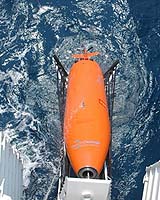
Surveyor 2 AUV Begins Gulf Of Mexico Projects
Lafayette LA (SPX) Sep 16, 2005 C & C Technologies' second deepwater AUV, C-Surveyor II, recently began field operations in the Gulf of Mexico. The C-Surveyor II vehicle was initially delivered to C & C's corporate headquarters in Lafayette, Louisiana on June 3, 2005. Over a period of three months, C & C system engineers integrated proprietary hardware and software into this next generation AUV and mobilized it on its mother ship the R/V Northern Resolution. The C-Surveyor II AUV is modeled after C & C's existing state-of-the-art AUV, C-Surveyor I, and includes numerous advancements. Survey sensors onboard include a multibeam echosounder, chirp side scan sonar, chirp sub-bottom profiler, methane detector, CTD system, and an Edgetech DW106 sub-bottom profiler customized with narrow transmit and receive beams to permit significantly deeper seabed penetration. In December 2005, C & C intends to upgrade the chirp side scan sonar to a new Dynamically Focused (DF) sidescan sonar system capable of providing five times more resolution than traditional systems. Over the next three months, C & C will be performing various surveys for government agencies, as well as the oil and gas industry. These projects include block hazard, pipeline hazard and investigation surveys. C & C, the undisputed worldwide leader in commercial deepwater AUV operations, has the largest market share of any operator. Over the last five years, C & C has surveyed more than 45,000 line-km worldwide on 77 AUV projects. C & C Technologies provides a variety of survey services including high accuracy Globally-corrected GPS services, marine construction surveys, high-resolution geophysical surveys and geotechnical surveys including full laboratory testing. For more information regarding C & C Community Email This Article Comment On This Article Related Links C & C Technologies SpaceDaily Search SpaceDaily Subscribe To SpaceDaily Express All about the robots on Earth and beyond!
 Spider Robots And The Space Web
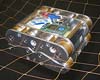 Noordwijk, The Netherlands (SPX) Dec 13, 2005
Robotic 'spiders' could be the key to building large-scale structures in space, according to ESA's Advanced Concepts Team. The tiny mechanical spiders would inch their way across large nets of fabric in space performing small tasks or lining up to create an antenna or some other structure. |
|
|

| The content herein, unless otherwise known to be public domain, are Copyright 1995-2006 - SpaceDaily.AFP and UPI Wire Stories are copyright Agence France-Presse and United Press International. ESA PortalReports are copyright European Space Agency. All NASA sourced material is public domain. Additionalcopyrights may apply in whole or part to other bona fide parties. Advertising does not imply endorsement,agreement or approval of any opinions, statements or information provided by SpaceDaily on any Web page published or hosted by SpaceDaily. Privacy Statement |