|
 |
 |
 |
 |
 |
 |
 |
 |

 |
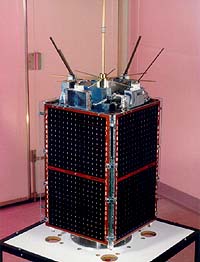
Surrey-built PICOSat launched for US Air Force
Guildford - Oct 1, 2001 PICOSat, a 67kg microsatellite developed for the US Air Force (USAF) Space Test Program (STP) by Surrey Satellite Technology Limited (SSTL) in the UK, was launched successfully from Alaska on 30th September. The PICOSat mission is demonstrating the viability of utilizing a commercial-off-the-shelf (COTS) spacecraft platform to provide cost-effective and timely space flights for Department of Defense (DoD) experiments. This is the first time that the DoD has purchased an �off-the-shelf� microsatellite, which has been tailored by SSTL to carry four experimental payloads for the US Government. It is also the first time that the STP has purchased a spacecraft outside of the United States. The US DoD�s objective is to achieve faster mission response and turnaround, cheaper life-cycle mission costs and more streamline programme execution. SSTL has a flight proven heritage of 17 microsatellite missions launched since 1981 and a mission philosophy of �low cost, rapid access to space, with a high degree of flexibility while minimizing risks�. Each SSTL mission is typically accomplished within 12-18 months from contract signing to flight readiness. Turn-key missions allow customers to benefit from the Company�s proven modular satellite platform, highly automated Mission Control Centre in Guildford (UK) and streamlined mission operations. SSTL has provided the PICOSat Mission Team with an off-the-shelf, cost effective satellite platform, with minimal modification and significant spaceflight heritage in order to drive down costs and drive up likelihood of mission success. Professor Martin Sweeting, CEO at SSTL said: �We were delighted to be chosen by the USAF Space Test Program to build a small, but advanced, microsatellite to carry four experimental-technology payloads into space. SSTL has delivered a capable, yet low cost spacecraft, that meets the needs of the USAF Space Test Program on time and within budget. PICOSat demonstrates the flexibility, versatility and capability of our microsatellite design.� PICOSat marks the 20th small satellite launch for SSTL in 20 years and more than 150 orbit-years of satellite operations. �Following yesterday�s successful launch and with commissioning under way in orbit�, said Sweeting, �we look forward to continuing and further developing our relationship with the US Air Force. Since the commencement of the PICOSat contract, SSTL have launched a further two 50kg microsatellites, a 320kg minisatellite and 6.5kg nanosatellite. Two nanosatellite assemblies have also been delivered to the US Air Force European Organisation for Aerospace Research & Development (EOARD). Our research and development programmes continue with interplanetary and geostationary missions already on the design boards � all designed within our philosophy of �low cost, rapid access to space�. Onboard PICOSat are four experimental payloads:
Lt Col Ballard from the USAF said: �The launch into a 800km orbit was carried out by an Athena launch vehicle from Kodiak Island at 02:40 UTC � only the second orbital launch from this site.� A joint Surrey / US Air Force Academy (USAFA) team in Colorado Springs have reported the successful command and activitation of PICOSat in-orbit. The satellite downlink was activated during the first pass over the USAFA following launch and all telemetry indications are healthy. The loading of flight software into the on-board computer and attitude dynamics detumbling operations have proceeded well. Housekeeping data downloaded has confirmed that the spacecraft is operating normally. Community Email This Article Comment On This Article Related Links Surrey Satellite Technology Limited SpaceDaily Search SpaceDaily Subscribe To SpaceDaily Express Microsat News and Nanosat News at SpaceMart.com
 Small Satellite Solutions From Scotland
 Clyde, Scotland (SPX) Jan 12, 2006
Clyde Space are offering the growing ranks of small satellite manufacturers power subsystem solutions for their missions. Based in purpose built facilities on West of Scotland Science Park in Glasgow, Clyde Space has a range of power subsystems for missions from as little as 1W up to in excess of 2.5kW. |
|
|

|
|
|
|
|
|
|
|
|
|
|
|
| The content herein, unless otherwise known to be public domain, are Copyright 1995-2006 - SpaceDaily.AFP and UPI Wire Stories are copyright Agence France-Presse and United Press International. ESA PortalReports are copyright European Space Agency. All NASA sourced material is public domain. Additionalcopyrights may apply in whole or part to other bona fide parties. Advertising does not imply endorsement,agreement or approval of any opinions, statements or information provided by SpaceDaily on any Web page published or hosted by SpaceDaily. Privacy Statement |