|
 |
 |
 |
 |
 |
 |
 |
 |

 |
Surrey Buys Multiple Cosmos Rockets For Microsat Launches
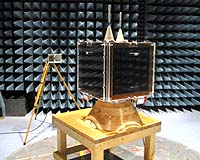
Farnborough - Jul 24, 2002 Surrey Satellite Technology Ltd (SSTL) of the UK and Rosoboronexport of Russia today signed a contract to launch 8 microsatellites on 3 Cosmos rockets from the Plesetsk Cosmodrome during 2002-2004. Seven of the advanced Earth Observation microsatellites will be injected into the same orbit by the three Cosmos rockets in order to form the first international constellation dedicated to monitoring natural and man-made disasters. The eighth microsatellite is a demonstration high resolution Earth Observation microsatellite for the UK British National Space Centre. Seven of the microsatellites are being constructed by SSTL in the UK in collaboration with its international partners. Cosmos and RBE were selected by SSTL for this important mission due to their capabilities to achieve the necessary orbital injection accuracy into a sun-synchronous orbit within the timescales needed by SSTL and at an affordable price. Cosmos, built by Polyot of Omsk, has an excellent record and was previously used by SSTL to launch successfully its SNAP-1 nanosatellite and the Tsinghua-1 microsatellite for China in June 2000. The first launch for SSTL, carrying the first DMC microsatellite AlSAT-1, is scheduled for autumn 2002. In a remarkable example of international collaboration in space, seven organisations from Africa, Asia and Europe have formed a consortium and agreed to contribute microsatellites into the first dedicated Disaster Monitoring Constellation (DMC). The DMC will comprise seven Earth observation microsatellites launched into low Earth orbit to provide daily imaging revisit anywhere in the world. The DMC Consortium comprises a partnership between organisations in Algeria, China, Nigeria, Thailand, Turkey, Vietnam and the United Kingdom. Each organisation is building an advanced yet low-cost Earth observation microsatellite to form the first ever constellation specifically designed and dedicated to monitoring natural and man-made disasters. The first DMC microsatellite is scheduled to be launched for Algeria in autumn 2002 and subsequent microsatellites into the same orbit in spring 2003 & 2004. The objective of the Consortium is to derive the maximum mutual benefit from the constellation through collaboration and cooperation between the DMC Partners. The partners in the DMC Consortium agreed to exchange their DMC satellite resources and data to achieve a daily Earth observation imaging capability for disaster monitoring and other dynamic phenomena. The DMC will enable the monitoring of any rapidly-changing phenomena by providing daily revisit multispectral imaging worldwide at resolutions from 32-metres multispectral down to 4-metres panchromatic. Current Earth observation satellites offer only infrequent image revisits and the delivery of critical information may take months due to periodic cloud cover and tasking conflicts. Images of disaster-stricken areas are often made available too late to be of real use to relief co-ordination agencies on the ground. The processed images from the DMC will be distributed to relief teams by the Reuters AlterNet Foundation. The Reuters Foundation launched AlertNet in 1997 to help the work of relief professionals around the world. Each year natural and man-made disasters around the world cause devastation, loss of life, widespread human suffering and huge economic losses. The DMC will provide a service that will greatly aid the response, management and mitigation of disasters whenever, and wherever, they occur. The DMC is an international project proposed and led by SSTL at the Surrey Space Centre, which has developed highly capable microsatellites that provide high quality multispectral imaging at a small fraction of the cost of a conventional satellite, thus making the constellation and this humanitarian service both practicable and affordable. The DMC partner organisations are: Centre National Techniques Spatiales (Algeria) Ministry of Science & Technology (PR China) National Space Research & Development Agency (Nigeria) TUBITAK-ODTU (Turkey) Mahanakorn University of Technology, Bangkok (Thailand) National Centre for Science & Technology (Vietnam) British National Space Centre (UK) Surrey Satellite Technology Ltd (UK) Six of the seven microsatellites for the DMC are being constructed at SSTL in the UK. The first satellite of the constellation, AlSAT-1 for Algeria, has been completed and is currently undergoing final tests in preparation for the planned launch in autumn 2002. Construction of BILSAT-1 (Turkey) is underway at SSTL, along with the UK-DMC microsatellite funded through the BNSC and NigeriaSat-1. The satellites for Algeria, Turkey and Nigeria are being built under a Know-How Transfer and Training (KHTT) programme at Surrey. The seventh microsatellite (Thai-Paht2) is being built at the Mahanakorn University of Technology (MUT) in Bangkok, Thailand. This follows MUT's successful KHTT programme with Surrey and the launch of their first microsatellite (Thai-Paht-1) in 1998. The Chinese and Vietnamese satellites are in the final stages of contract negotiation with SSTL and both are planned to be built at Surrey. Community Email This Article Comment On This Article Related Links Surrey Satellite Technology Limited Algeria - Centre National Techniques Spatiales China - Ministry of Science & Technolgy Thailand - Mahanakorn University of Technolgy Turkey - TUBITAK-ODTU Vietnam - National Centre for Science & Technology UK - British National Space Centre SpaceDaily Search SpaceDaily Subscribe To SpaceDaily Express Microsat News and Nanosat News at SpaceMart.com
 Small Satellite Solutions From Scotland
 Clyde, Scotland (SPX) Jan 12, 2006
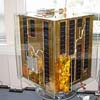
Clyde Space are offering the growing ranks of small satellite manufacturers power subsystem solutions for their missions. Based in purpose built facilities on West of Scotland Science Park in Glasgow, Clyde Space has a range of power subsystems for missions from as little as 1W up to in excess of 2.5kW. |
|
|

| The content herein, unless otherwise known to be public domain, are Copyright 1995-2006 - SpaceDaily.AFP and UPI Wire Stories are copyright Agence France-Presse and United Press International. ESA PortalReports are copyright European Space Agency. All NASA sourced material is public domain. Additionalcopyrights may apply in whole or part to other bona fide parties. Advertising does not imply endorsement,agreement or approval of any opinions, statements or information provided by SpaceDaily on any Web page published or hosted by SpaceDaily. Privacy Statement |