|
 |
 |
 |
 |
 |
 |
 |
 |

 |
Surprising Discovery May Lead to Better Understanding of Water Quality
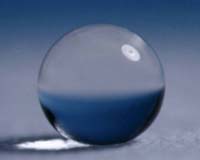
Argonne IL (SPX) Jul 12, 2006 Scientists at the U.S. Department of Energy's Argonne National Laboratory have discovered new ways that ions interact with mineral surfaces in water, opening a door to new knowledge on how contaminants travel in the environment. The insight, leads to a better understanding of the factors that determine water quality. Water - colorless, odorless and tasteless - may seem simple, but its interaction with minerals can be difficult to study. Ions (ranging from nutrients such as calcium, to contaminants such as lead) are present in natural waters, but their transport is often limited by adsorption to mineral surfaces. The more scientists can understand about the interaction of minerals with water and ions, the more effectively they can control water quality in our environment, and Argonne's research in this area is making a leading contribution to the field. Contrary to generally held scientific assumptions, the simple textbook description of how ions adsorb to mineral-water interfaces has been shown to not be universally true. Argonne Physicist Paul Fenter stated "Ions are known to carry a hydration shell in water. Previously, it was thought that ions either adsorb to a mineral surface with this shell intact as an outer-sphere ion, or remove part of this shell to directly bind to the mineral as an inner-sphere ion. We now know that this is not just a black and white difference, but have discovered new shades of gray by showing that outer-sphere and inner-sphere species of the same ion can co-exist.� This revelation was the outcome of a new element-specific method developed to understand the behavior of ions at the interface between minerals and liquids, like water. According to Argonne Chemist Changyong Park, "Conventional methods provided no direct sensitivity to observing this behavior. Outer-sphere species were almost invisible and extremely difficult to identify. There was just no way to see the co-existence of both species previously." Using the Advanced Photon Source (APS) at Argonne, which provides the western hemisphere's most brilliant x-ray beams for research, the team was able to make this new discovery. These x-rays enabled scientists to pursue new knowledge about the structure and function of materials - and develop new methods for scientific study. Using the APS, the team was able to take advantage of the technique's spectroscopic sensitivity to identify the way specific ions interact at mineral-water interfaces and visualize the phenomena directly. The findings built on earlier work on cation adsorption using traditional x-ray scattering techniques. The Argonne scientists, working together with researchers from the University of Illinois at Chicago Department of Earth and Environmental Sciences, previously discovered an anomaly in the way that ions adsorb. The team collaborated again with the new element-specific technique which led to this new discovery, central to understanding the behavior of ions at solid-liquid interfaces. Water is the "universal solvent", dissolving more substances than any other liquid. This means that wherever water goes, either through the ground or through our bodies, it takes ions along with it. A general understanding of this behavior and the development of a new scientific method for studying this phenomenon may lead to better understanding of various other processes that take place at solid-liquid interfaces, including corrosion, erosion, catalysis, and even the biological behavior of cell membranes. Community Email This Article Comment On This Article Related Links Argonne National Laboratory Water News - Science, Technology and Politics
 Indian Supreme Court Refuses To Halt Controversial Dam Project
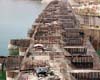 New Delhi (AFP) Jul 11, 2006
India's Supreme Court has refused to halt work to raise the height of a controversial dam after a plea by the prime minister that the project is important for development, a lawyer said Tuesday. |
|
|

| The content herein, unless otherwise known to be public domain, are Copyright 1995-2006 - SpaceDaily.AFP and UPI Wire Stories are copyright Agence France-Presse and United Press International. ESA PortalReports are copyright European Space Agency. All NASA sourced material is public domain. Additionalcopyrights may apply in whole or part to other bona fide parties. Advertising does not imply endorsement,agreement or approval of any opinions, statements or information provided by SpaceDaily on any Web page published or hosted by SpaceDaily. Privacy Statement |