|
 |
 |
 |
 |
 |
 |
 |
 |

 |
Surprises From Mercury
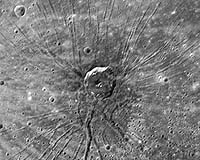
Washington DC (SPX) Feb 01, 2008 After a journey of more than 2 billion miles and three and a half years, NASA's MESSENGER spacecraft flew by Mercury on Jan. 14, 2008, and it has beamed back some surprises. "This flyby allowed us to see a part of the planet never before viewed by spacecraft, and our little craft has returned a gold mine of exciting data," said Sean Solomon, MESSENGER's principal investigator at the Carnegie Institution of Washington. The spacecraft's cameras and other sensors collected more than 1,200 images and made the first up-close measurements of Mercury since Mariner 10 visited the planet in the mid-1970s. Researchers once thought Mercury to be much like Earth's moon, but MESSENGER has found many differences. For instance, unlike the moon, Mercury has huge cliffs with structures snaking hundreds of miles across the planet's face. The spacecraft also revealed impact craters that appear very different from lunar craters. One particularly curious crater has been dubbed "The Spider." This formation never has been seen on Mercury before and nothing like it has been observed on the moon. It lies in the middle of a huge impact crater called the Caloris basin and consists of more than 100 narrow, flat-floored troughs radiating from a complex central region. "The Spider has a crater near its center, but whether that crater is related to the original formation or came later is not clear at this time," said James Head, science team co-investigator at Brown University, Providence, R.I. When Mariner 10 flew by Mercury in the 1970s, it saw only a portion of Caloris basin. Now that MESSENGER has shown scientists the basin's full extent, its diameter has been revised upward from the Mariner 10 estimate of 800 miles to perhaps as large as 960 miles from rim to rim. Researchers already knew that Caloris was one of the largest impact craters in the solar system; MESSENGER has shown it is even bigger than they thought! Turning to Mercury's magnetic field, MESSENGER found it to be different compared to Mariner 10 observations 30 years ago. While the magnetic field was generally quiet (no magnetic storms) on Jan. 14th, it showed several signs of significant internal pressure. Additional flybys by MESSENGER in late 2008 and 2009 plus a yearlong orbital phase beginning in 2011 will shed more light on the stability and dynamics of Mercury's magnetic cocoon. MESSENGER's suite of instruments also detected ultraviolet emissions from sodium, calcium and hydrogen in Mercury's exosphere. (An exosphere is a super-low-density atmosphere probably formed, in this case, from atoms sputtering off Mercury's surface. The sputtering may be caused by contact with hot plasma trapped in Mercury's magnetic field.) MESSENGER encountered Mercury's sodium-rich exospheric "tail" which extends more than 25,000 miles from the planet and also discovered a hydrogen tail of similar dimensions. "We should keep this treasure trove of data in perspective," said project scientist Ralph McNutt of the Applied Physics Laboratory, Laurel, Md. "With two flybys to come and an intensive orbital mission to follow, we are just getting started to go where no one has been before." Community Email This Article Comment On This Article Related Links Mercury at APL News Flash at Mercury Mars News and Information at MarsDaily.com Lunar Dreams and more
 Mercury Magnetosphere Fends Off The Solar Wind
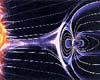 Ann Arbor MI (SPX) Feb 01, 2008
The planet Mercury's magnetic field appears to be strong enough to fend off the harsh solar wind from most of its surface, according to data gathered in part by a University of Michigan instrument onboard NASA's MESSENGER spacecraft. |
|
|

| The content herein, unless otherwise known to be public domain, are Copyright 1995-2007 - SpaceDaily.AFP and UPI Wire Stories are copyright Agence France-Presse and United Press International. ESA Portal Reports are copyright European Space Agency. All NASA sourced material is public domain. Additional copyrights may apply in whole or part to other bona fide parties. Advertising does not imply endorsement,agreement or approval of any opinions, statements or information provided by SpaceDaily on any Web page published or hosted by SpaceDaily. Privacy Statement |