
 |
 |
 |
 |
 |
 |
 |
 |
 |

 |
Surprise quake shows Japan's vulnerability: experts
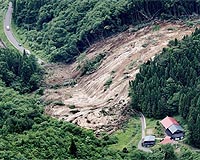
Tokyo (AFP) June 15, 2008 A powerful earthquake in Japan struck at a previously unknown faultline, raising new alarm that the dreaded "Big One" could hit anywhere in the country, experts said Sunday. The 7.2-magnitude quake Saturday was the most powerful to strike inland Japan in eight years, killing at least nine people and triggering massive landslides. "Seismically speaking, major earthquakes can strike anywhere and anytime in Japan," said Ryohei Morimoto, a seismologist and honorary professor at the University of Tokyo. "Therefore, it would be no surprise if another earthquake matching the one on Saturday occurs in any part of the country in the near future," Morimoto said. The meteorological agency said it had predicted an offshore jolt could strike near the region, in the north of Japan's main island of Honshu, but admitted it did not consider the inland area at major risk. "We had not been aware of faults in the area where the earthquake occurred this time," Takashi Yokota, a senior official of the agency's earthquake and tsunami monitoring bureau, told a news conference. Experts said that the quake, whose focus was located a shallow eight kilometres (five miles) deep, was triggered due to the build-up of pressure where the Pacific Plate meets the Japanese archipelago. Japan, which lies at the crossing of four tectonic plates, experiences 20 percent of the world's powerful earthquakes and is constantly striving to protect against major tremors. Japan has started a world-first early warning system for earthquakes by monitoring seismic waves. The system kicked in on Saturday, offering alerts several seconds in advance. But much about earthquakes have yet to be understood, experts said. "A lot of questions have not been answered," said Yoshimasu Kuroda, honorary professor of geology and geochemistry at Shinshu University in Nagano, central Japan. "We have to face this reality," Kuroda said. "All we can do is to collect as much information as possible from the latest one and analyse it for better understanding of the Earth." Despite the massive strength of the tremor, damage to facilities and casualties were limited as it hit rural areas. About 9.7 million people live in the rice-growing region, accounting for seven percent of Japan's population. By contrast, a government study in 2006 warned that a 7.3 Richter-scale earthquake in Tokyo would kill 4,700 people and damage 440,000 buildings. The last giant tremor in Tokyo was the Great Kanto Earthquake of 1923, which left 142,807 people dead. The 1995 Kobe earthquake, which measured 7.3 on the Richter scale, killed 6,434 people. It caused 200 billion dollars in economic damage, considered the highest ever to a single country from a disaster. Community Email This Article Comment On This Article Share This Article With Planet Earth
Related Links Tectonic Science and News
 Mountain Ranges Rise Much More Rapidly Than Geologists Expected
 Rochester NY (SPX) Jun 10, 2008
Mountains may experience a "growth spurt" that can double their heights in as little as two to four million years-several times faster than the prevailing tectonic theory suggests. |
|
|

| The content herein, unless otherwise known to be public domain, are Copyright 1995-2007 - SpaceDaily.AFP and UPI Wire Stories are copyright Agence France-Presse and United Press International. ESA Portal Reports are copyright European Space Agency. All NASA sourced material is public domain. Additional copyrights may apply in whole or part to other bona fide parties. Advertising does not imply endorsement,agreement or approval of any opinions, statements or information provided by SpaceDaily on any Web page published or hosted by SpaceDaily. Privacy Statement |
 del.icio.us
 Digg
Digg Reddit
 YahooMyWeb
 Google
 Facebook