|
 |
 |
 |
 |
 |
 |
 |
 |

 |
Surfing The Wave
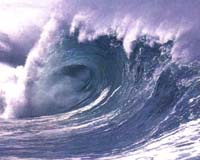
Moffett Field CA (SPX) Sep 14, 2004 Earth is the only planet we know of that has life, but it is not exactly a safe haven. Planetary processes such as volcanoes, earthquakes, extreme weather and climate change often threaten life, and sometimes have led to the extinction of species. A tsunami, while not a cause of extinction, is one of the many hazards of living on Earth. Tsunamis are large waves caused by the disruption of seawater. Earthquakes on the ocean floor generate most tsunamis, but they also may result from the eruption or collapse of island or coastal volcanoes, or from giant landslides on the edge of the sea. According to Professor Bill McGuire, Director of University College London's Benfield Hazard Research Centre, a mega-tsunami could someday cause death and destruction to the eastern coasts of North and South America and the western coast of Africa. At a recent media briefing organized by the Science Media Centre in London, McGuire said that the western flank of the Cumbre Vieja volcanoes on the Canary Island of La Palma will collapse. This would create a series of waves that could travel great distances, sending vast walls of water all the way across the Atlantic at speeds up to 800 kilometers per hour. The Cumbre Vieja are a ring of volcanic mountains measuring 1,600 to 2,400 meters high. The most recent activity in this ring was the 1971 eruption from the Tenegu�a vent. A portion of the mountain ring began to slide into the ocean during an eruption in 1949. McGuire fears that when it finally collapses, the resulting tsunami will hit land on both sides of the Atlantic within a matter of hours. The triggering factor for this collapse could be another eruption of the volcano, which is predicted to erupt every 25 to 200 years. McGuire says that the volcano could erupt anytime, but since there is almost no monitoring of the volcano, there is little chance of advance warning. He said a giant tidal wave, which could measure 100 meters from crest to trough, would hit the other Canary islands within an hour and reach the north African coast within two hours. Substantial tsunami waves also would hit the Atlantic coasts of Britain, Spain, Portugal and France. Between seven and 10 hours later, waves tens of meters high would crash onto the Caribbean islands and the eastern seaboards of North and South America. However, a report by the Tsunami Society issued in 2003 says that such reports of mega-tsunamis are just "scaremongering." The Tsunami Society is a group of scientists that aims to educate society about the threat of tsunamis. In 2003, the Discovery Channel featured a program claiming that the coastal Atlantic region would be destroyed by waves generated by a volcanic collapse in the Canary Islands - the same claim that McGuire is making. "While the active volcano of Cumbre Vieja on Las Palma is expected to erupt again, it will not send a large part of the island into the ocean, though small landslides may occur. The Discovery program does not bring out in the interviews that such volcanic collapses are extremely rare events, separated in geologic time by thousands or even millions of years," says the Tsunami Society web site. "No such event - a mega-tsunami - has occurred in either the Atlantic or Pacific oceans in recorded history. NONE." The Tsunami Society notes that the eruptions of Krakatau and Santorini did generate catastrophic tsunami waves, but these waves did not travel to far-distant shores. Krakatau (or Krakatoa) was a volcano on the Indonesian island of Rakata. It erupted in 1883, generating waves as high as 40 meters above sea level. This tsunami killed over 36,000 people in Sumatra and Java, and rocked ships as far away as South Africa. The Santorini (or Thera) eruption probably occurred sometime between 1650 and 1598 BC, and generated a tsunami that reached as high as 100 to 150 meters above sea level. This tsunami devastated the north coast of Crete, 70 kilometers away. The Tsunami Society says that models on such events - and of the postulated Las Palma event - suggest that the waves they generate do not travel as far as tsunami waves created by a major earthquake. But McGuire says that none of the scientists who make up the Tsunami Society have studied La Palma. He insists that the unstable flank of the Cumbre Vieja will collapse into the sea as a single block, creating a large tsunami that could travel great distances. "The Tsunami Society does not contain any volcanologists, and it shows," says McGuire. "On the Canary Island of El Hierro we have an aborted collapse - the San Andres - which dropped 300 meters as a single coherent block before grinding to a halt through lack of lubricating water. The catastrophic speed of collapse is confirmed by melting along the slide surface." The model used for the collapse of the Cumbre Vieja was published in Geophysical Research Letters, a publication of the American Geophysical Union, by Simon Day, McGuire's colleague at the Benfield Hazard Research Centre, and by Steve Ward of University of California, Santa Cruz. McGuire says this model has been used to successfully describe collapses that have already happened, such as the Storegga slide in Norway and the 1888 Ritter Island collapse in Papua New Guinea. The Storegga slide occurred over 7,000 years ago, and generated a large tsunami that swamped parts of western Norway. The tsunami raced across the North Atlantic and Norwegian Sea and traveled as far south as eastern England. In 1888, the sudden collapse of the Ritter Island volcano generated waves up to 12 to 15 meters above sea level that killed as many as 3,000 people on nearby islands. Community Email This Article Comment On This Article Related Links Benfield Hazard Research Centre SpaceDaily Search SpaceDaily Subscribe To SpaceDaily Express Tectonic Science and News
 Ash Continuing To Spew From Vanuatu Volcano
 Sydney (AFP) Dec 12, 2005
Thousands of tonnes of ash are continuing to spew from a volcano in Vanuatu, but officials said Monday the activity on the South Pacific nation was not likely to result in a major deadly eruption. |
|
|

| The content herein, unless otherwise known to be public domain, are Copyright 1995-2006 - SpaceDaily.AFP and UPI Wire Stories are copyright Agence France-Presse and United Press International. ESA PortalReports are copyright European Space Agency. All NASA sourced material is public domain. Additionalcopyrights may apply in whole or part to other bona fide parties. Advertising does not imply endorsement,agreement or approval of any opinions, statements or information provided by SpaceDaily on any Web page published or hosted by SpaceDaily. Privacy Statement |