|
 |
 |
 |
 |
 |
 |
 |
 |

 |
Superdiamonds? - Scientists Discover Superconductivity In Diamond
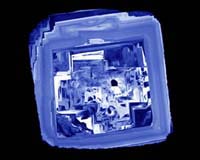
Los Alamos - Apr 02, 2004 Scientists working at the Russian Academy of Sciences and Los Alamos National Laboratory announced today the discovery of superconductivity at ultracold temperatures in cubic diamond. The discovery offers the potential for a new generation of diamond-based device applications and even suggests that superconductivity in silicon or germanium, which also forms in the diamond structure, may be possible. In findings published in today's issue of the scientific journal Nature, the Russian - American team of scientists report their discovery of superconductivity in a boron-doped diamond-structured carbon material that had been synthesized at very high pressures and temperatures. The diamond material was fabricated in Russia by scientists working at the Institute for High Pressure Physics (IHPP) at the Russian Academy of Sciences and brought to Los Alamos where superconductivity in diamond was discovered. According to Vladimir Sidorov, a scientist who works at both IHPP and Los Alamos, "gem diamonds are desired for their sparkling brilliance and extreme hardness. This discovery of a totally unexpected new facet of diamond enhances its desirability, not to the well-attired, but to science and technology." Diamonds conduct heat more effectively than copper and can withstand very high electric fields. These properties are the result of the ways in which electrons arrange themselves in the atomic structure of diamond. This same electron arrangement makes it impossible for diamond to conduct electricity. However, by subjecting a graphite and boron carbide mixture to pressures of nearly 100,000 atmospheres and temperatures of roughly 4,000 to 4,600 degrees Fahrenheit, scientists were able to transform diamonds from a 'supergem' to a superconductor that carries electricity with no resistance at a temperature of minus 450 degrees Fahrenheit. Boron atoms have one less electron than carbon atoms and because of their small atomic radius boron atoms are relatively easily incorporated into the diamond atomic structure. Separately, both boron and diamond are not electrical charge conductors, but instead are quite good insulators. Once they are combined, the resulting diamond becomes doped with electrical charge carriers. Incorporating a small number of these charge carriers in diamond allows fabrication of transistors, but adding more carriers creates superconductivity. While there is a great deal of research yet to do, the discovery of superconductivity in diamond-structured carbon suggests that new forms of diamond-based integrated circuits may be possible. Silicon or germanium, which also form in the diamond structure, may also exhibit superconductivity under certain conditions. Although it is highly speculative at this point, this means that someday scientists might be able to create a form of superconducting silicon that would allow computers to operate even faster than imagined. Community Email This Article Comment On This Article Related Links Los Alamos National Laboratory SpaceDaily Search SpaceDaily Subscribe To SpaceDaily Express Space Technology News - Applications and Research
 Industry Team Achieve New Communications Technology With AESA Radars
 Baltimore MD (SPX) Jan 12, 2006
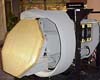
A team comprised of three leading US aerospace and defense contractors has demonstrated an innovative technological use of active electronically scanned array (AESA) radars for high-bandwidth communications. |
|
|

| The content herein, unless otherwise known to be public domain, are Copyright 1995-2006 - SpaceDaily.AFP and UPI Wire Stories are copyright Agence France-Presse and United Press International. ESA PortalReports are copyright European Space Agency. All NASA sourced material is public domain. Additionalcopyrights may apply in whole or part to other bona fide parties. Advertising does not imply endorsement,agreement or approval of any opinions, statements or information provided by SpaceDaily on any Web page published or hosted by SpaceDaily. Privacy Statement |