|
 |
 |
 |
 |
 |
 |
 |
 |

 |
Supercomputers Help Physicists Understand A Force Of Nature
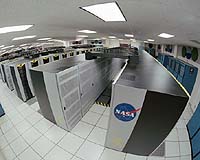
Los Angeles CA (SPX) Jul 18, 2006 What if the tiniest components of matter were somehow different from the way they exist now, perhaps only slightly different or maybe a lot? What if they had been different from the moment the universe began in the Big Bang? Would matter as we know it be the same? Would humans even exist? Scientists are seeking answers to some profound questions such as these, thanks to a breakthrough in the calculations needed to understand the strong nuclear force that comes from the motion of nature's basic building blocks: subatomic particles called quarks and gluons. The strong nuclear force that binds these particles together, also known as quantum chromodynamics, is one of the four basic forces of nature, along with gravity, electromagnetism and the weak force. The strong nuclear force is extremely powerful at extremely short ranges, binding quarks and gluons into neutrons and protons at the core of atoms. The basic equations that describe the nuclear force have been known since the mid 1970s, and were the subject of the 2004 Nobel Prize in physics. Still, physicists know very little of how the force described by these equations binds protons and neutrons into the nuclei of atoms. Now a team of researchers using a supercomputer and a method called lattice quantum chromodynamics have been able to calculate interactions among neutrons and protons from the properties of quarks and gluons. The lattice essentially divides the space-time continuum into a four-dimensional grid, allowing the researchers to examine the effects of the strong force, which becomes important at distances of one 100-trillionth (or 10 to the -15th) of a meter or less. The new calculation is a first step toward understanding how nuclear forces emerge from the interactions between quarks and gluons, said research team member Martin Savage, of the University of Washington in Seattle. "We're showing that techniques exist today to compute a nuclear reaction from the underlying theory of strong interactions," Savage said. "It is a simple reaction in terms of neutrons and protons, but it is a start." It is enough of a start for theoretical physicists to begin tackling questions such as how the universe might be different if quarks were slightly lighter or heavier than they actually are. The work also will let researchers perform calculations that could, for instance, provide clearer understanding of what the interior of a body such as a neutron star looks like. "This will help us to understand how finely tuned the universe is," Savage said. "If you change the values of the fundamental constants of nature, would the universe still produce stars? Or humans?" Having a framework to calculate nuclear interactions in terms of quarks and gluons paves the way for reaching a greater understanding of the nature of the universe, particularly as supercomputers become increasingly powerful in the coming years, Savage said. "We can start to explore how the structure of nuclei would change if the quark masses differed from the values found in nature," he said. "We hope we can determine if the quark masses in nature, or values very close to them, are required for carbon-based life to exist in our universe, or if any old quark masses would do." The work is described in a paper published July 7 in Physical Review Letters. Other authors are Silas Beane, an assistant professor of physics at the University of New Hampshire; Paulo Bedaque, an assistant professor of physics at the University of Maryland; and Konstantinos Orginos, an assistant professor of physics at the College of William and Mary in Virginia and a member of the theory group at the Thomas Jefferson National Accelerator Facility in Virginia. Community Email This Article Comment On This Article Related Links All about the technology of space and more Space Technology News - Applications and Research
 Australian DTH TV Service To Use Harmonic IP-Based MPEG-2 Video Solution
 Sunnyvale CA (SPX) Jul 18, 2006
Harmonic has announced that SELECTV has deployed its IP-based compression and multiplexing solutions for its direct-to-home satellite pay TV service in Australia. |
|
|

| The content herein, unless otherwise known to be public domain, are Copyright 1995-2006 - SpaceDaily.AFP and UPI Wire Stories are copyright Agence France-Presse and United Press International. ESA PortalReports are copyright European Space Agency. All NASA sourced material is public domain. Additionalcopyrights may apply in whole or part to other bona fide parties. Advertising does not imply endorsement,agreement or approval of any opinions, statements or information provided by SpaceDaily on any Web page published or hosted by SpaceDaily. Privacy Statement |