|
 |
 |
 |
 |
 |
 |
 |
 |

 |
Super-Heavy Nuclei Take Shape In 'Extreme' New Theories
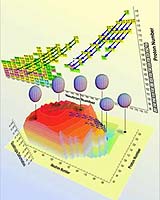
Oak Ridge TN (SPX) Feb 21, 2005 Advanced computational methods and supporting experiments, including work performed at the Department of Energy's Oak Ridge National Laboratory, are giving scientists a better understanding of the nature and stability of superheavy nuclei and the heaviest elements that lie beyond the borders of the periodic table. Nature magazine on Thursday published a review article that describes collaborative work by researchers at Oak Ridge National Laboratory and the University of Tennessee and researchers at universities in Poland and Belgium. The authors describe the behavior of super-heavy nuclei -- those chock full of protons and neutrons to the point that they tax the physical forces that hold them together. "Predicting the stabilities of extremely heavy nuclei has been a long-term goal of nuclear scientists. This research represents the very best we can do at predicting the structure of these species," said Witold Nazarewicz, a researcher in ORNL's Physics Division and UT's Department of Physics and Astronomy. The paper describes how the protons and neutrons of extremely heavy nuclei arrange into shapes that can be oblong or flat. That shape can help determine the stability or life of the nucleus, which is, in turn, a factor in determining if the atomic species can even exist or be synthetically created. Because of strong electrostatic repulsion, some of these superheavy nuclei may have extremely short lifetimes. "A typical lifetime of a nucleus is in the extremely heavy range of a millisecond," said Nazarewicz. But in some cases, certain isotopes may be much more stable, or long-lived, and this stability may depend on the nuclear shape. Experiments performed at GSI in Germany, RIKEN in Japan, in Dubna, Russia, and elsewhere have bolstered theories that the lives of nuclei become longer as certain configurations of protons and neutrons are achieved. Computationally intense theoretical modeling indicates that a large difference in the shapes of a "parent" nucleus, which decays by emitting an alpha particle, and that of its "daughter" isotope will hinder the rate of decay to that daughter. "It takes time for a nucleus to decay from a flat, oblate shape to a well-deformed elongated shape. These protons and neutrons are rearranging themselves, and this shape change causes difficulty," said Nazarewicz. Some experiments indicate that the addition of neutrons to a nucleus can extend the life of an isotope of a superheavy element -- for instance the as-yet unnamed element 112 -- from a fraction of a second to more than 30 seconds. In terms of existence for extremely heavy nuclei, a half-minute is an eternity. Nuclei in the particularly well-bound isotopes find arrangements that physicists regard as "magic." Such nuclei are reminiscent of noble gases -- for instance, helium, argon and neon -- which because of their closed electron shells are so stable and unreactive that they are known as inert gases. Nuclei also can have closed shells of protons and neutrons. Lead-208 is the heaviest "doubly magic" nucleus with closed shells of 82 protons and 126 neutrons. "We do not really know what is the next doubly magic nucleus beyond lead-208" Nazarewicz said. Theorists like Nazarewicz and his Nature co-authors, the late S. Cwiok of the Warsaw University of Technology, Poland, and P.-H. Heenen of the Free University of Brussells, Belgium, believe that in the extremely heavy regions, the interplay of nuclear shapes and proton and neutron arrangements eventually will approach relatively stable, "near-magic" states. "These theories are supported by large-scale, state-of-the-art calculations. At the same time, lab experimenters are trying to understand the mechanisms of nuclear collisions. Experiments with beams of radioactive neutron-rich nuclei such as doubly magic tin-132 may teach us how to pump more neutrons into the nuclei of these super-heavy elements," said Nazarewicz, who is scientific director of ORNL's Holifield Radioactive Ion Beam Facility. The work was funded in part by the Office of Nuclear Physics in DOE's Office of Science and by the National Nuclear Security Administration. Oak Ridge National Laboratory is a multiprogram laboratory managed for the Department of Energy by UT-Battelle. Community Email This Article Comment On This Article Related Links Oak Ridge National Laboratory SpaceDaily Search SpaceDaily Subscribe To SpaceDaily Express Understanding Time and Space
 Unified Physics Theory Explains Animals Running Flying And Swimming
 Durham NC (SPX) Jan 05, 2006
A single unifying physics theory can essentially describe how animals of every ilk, from flying insects to fish, get around, researchers at Duke University's Pratt School of Engineering and Pennsylvania State University have found. The team reports that all animals bear the same stamp of physics in their design. |
|
|

| The content herein, unless otherwise known to be public domain, are Copyright 1995-2006 - SpaceDaily.AFP and UPI Wire Stories are copyright Agence France-Presse and United Press International. ESA PortalReports are copyright European Space Agency. All NASA sourced material is public domain. Additionalcopyrights may apply in whole or part to other bona fide parties. Advertising does not imply endorsement,agreement or approval of any opinions, statements or information provided by SpaceDaily on any Web page published or hosted by SpaceDaily. Privacy Statement |