|
 |
 |
 |
 |
 |
 |
 |
 |

 |
Sunset Planets
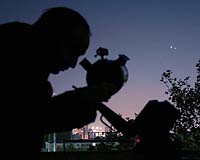
Huntsville AL (SPX) Aug 29, 2005 Something nice is happening in the sunset sky. Venus and Jupiter, the two brightest planets, are converging, and they're going to be beautifully close together for the next two weeks. Step outside tonight when the sun goes down and look west. If there are no trees or buildings in the way, you can't miss Jupiter and Venus. They look like airplanes, hovering near the horizon with their lights on full blast. (Venus is the brighter of the two.) You can see them even from brightly-lit cities. Try catching the pair just after sundown and just before the first stars appear. Venus and Jupiter pop into view while the sky is still twilight-blue. The scene has a special beauty. When the sky darkens completely, look to the left of Jupiter for Spica, the brightest star in the constellation Virgo. Although it's a bright star, Spica is completely outclassed by the two planets. Venus and Jupiter are converging at the noticeable rate of 1o per day, with closest approach coming on September 1st when the two will be a little more than 1o apart. (How much is 1o? Hold your pinky finger at arm's length. The tip is about 1o wide.) When planets are so close together, not only do you notice them, you'll have a hard time taking your eyes off them. They're spellbinding. There's a biological reason for this phenomenon: In the back of your eye, near the center of the retina, lies a small patch of tissue called "the fovea" where cones are extra-densely packed. "Whatever you see with the fovea, you see in high-definition," explains Stuart Hiroyasu, O.D., of Bishop, California. "The fovea is critical to reading, driving, watching television; it has the brain's attention." The field of view of the fovea is 5o. When two objects converge to, say, 1o as Venus and Jupiter will do, they can beam into your fovea simultaneously, signaling your brain�attention, please! After September 1st, the two planets separate, but the show's not over. On September 6th, with Jupiter and Venus still pleasingly close together, the slender crescent Moon will leap up from the sun's glare and join the two planets. Together, they'll form a compact triangle that will simply knock your socks off. Feel like staring? Do. Community Email This Article Comment On This Article Related Links SpaceDaily Search SpaceDaily Subscribe To SpaceDaily Express Astronomy News from Skynightly.com
 Venus Express Completes LEOP Activities
 Paris (ESA) Nov 15, 2005
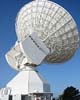
The Venus Express Launch and Early Orbit Phase (LEOP) activities again continued to run very smoothly. All foreseen activities were completed and it was also possible to bring forward some platform commissioning activities, which were planned for last weekend. |
|
|

| The content herein, unless otherwise known to be public domain, are Copyright 1995-2006 - SpaceDaily.AFP and UPI Wire Stories are copyright Agence France-Presse and United Press International. ESA PortalReports are copyright European Space Agency. All NASA sourced material is public domain. Additionalcopyrights may apply in whole or part to other bona fide parties. Advertising does not imply endorsement,agreement or approval of any opinions, statements or information provided by SpaceDaily on any Web page published or hosted by SpaceDaily. Privacy Statement |