|
 |
 |
 |
 |
 |
 |
 |
 |

 |
Sun Rise At South Pole Will Complete Eros Map
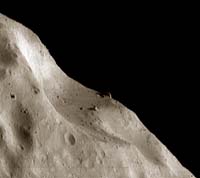
Laurel - July 25, 2000 - NEAR Shoemaker has by now imaged the entire surface of Eros at least once, but our task is not yet complete. The last portion of Eros to be imaged was the south pole, because this region has been in shadow until this month. Previously, during the southern winter, the sun never rose above the horizon at the south pole, but now that the sun has passed directly above the Eros equator heading south, it rises briefly each Eros day. However, the sun remains low in the sky even at local noon, and the terrain is heavily shadowed. As we need to obtain images under a variety of lighting conditions, we shall be imaging this area again in the coming months. We also need to fill in our color coverage of the far southern latitudes. Still, we can now be assured that the south polar region of Eros is not grossly dissimilar from other regions on Eros. We are convinced that the surface of Eros is covered with regolith, which is fragmented, particulate material; that most of the surface displays systems of grooves and ridges; that boulders are ubiquitous in the regolith; and that a variety of crater shapes and crater densities are seen. We are still attempting to synthesize the information we have gathered - to assemble an integrated picture of Eros the asteroid from the myriad pieces of the puzzle we have collected so far. We have not yet reached the halfway mark of the Eros orbital mission, and many pieces of the puzzle may still be missing. Still, after having seen all of the surface at least once, we are obliged to begin asking hard questions. One of these is whether the regolith material is resting loosely upon the surface, as opposed to being fixed in place with appreciable strength. That is, if we were to visit the surface, would we be able to scoop up material easily and pick up rocks, or would we find a hard surface that we would need to chisel or drill into? On the Moon, the regolith does rest loosely upon the surface, and it has the consistency of a very fine, dry dust. The lunar regolith can be scooped up easily. On Mars also, the regolith rests loosely upon the surface and has the consistency of fine dust; when the wind picks up on Mars, the dust is often lifted off the surface and can be blown all around the planet. However, just below the surface of the Martian regolith, there is a hard, cemented layer that the Viking landers were not able to dig through. On Eros, there is no atmosphere and no wind, but it is too early to say that the regolith must be like that of the Moon. NEAR Shoemaker has no direct means of measuring the strength of the surface, but we can make inferences. One approach is to study images at the highest possible resolution. We are often asked if the grooves on Eros could have been made by boulders as they come to rest after having been set into motion somehow - that is, could the grooves be troughs plowed up by boulders sliding or rolling along the surface? Examination of the images shows that this is not a viable mechanism. We have found no examples of grooves with boulders at one end, where the size of the boulder is plausibly consistent with making the groove. However, we are still puzzled by the boulders. We are asking, for example, whether they were emplaced as a result of any of the impacts that created the craters we now see on Eros. Alternatively, were the boulders pre-existing on Eros, and are they now being exposed by removal of regolith from above and around them? However, images are not the only tools that NEAR Shoemaker can use to make inferences about the regolith. Another approach is to use shape and gravity measurements of Eros to determine the strength and the direction of the acceleration of gravity at the surface. In other words, we ask whether loose material on the surface would fly away or slide off. Does material need to be cemented in place to maintain the surface slopes? To make this evaluation, we have to remember that Eros is rotating on its axis, so that any material resting on the surface would feel a centrifugal force that is directed away from the rotation axis and that tends to oppose gravity, especially at the equator. This centrifugal force is proportional to the distance from the rotation axis, so it is greatest at the ends of an elongated object like Eros. The acceleration of gravity also tends to be weakest at the ends, which are the farthest regions from the center. These forces generally do not oppose each other exactly, because the acceleration of gravity does not point exactly toward the center of an irregular body, whereas the centrifugal force does always point directly away from the rotation axis. Although this is a topic for another time, the rotation axis for an isolated body like Eros must always pass through the center of mass. The weight of an object on the surface is just the acceleration of gravity multiplied by the mass. On Earth, one's weight is slightly reduced by the action of the centrifugal force created by Earth's rotation. We do not normally notice this centrifugal force because Earth's rotation rate is small - only one rotation every 24 hours. Eros rotates somewhat more quickly, once every 5.27 hours. This difference is enough to make centrifugal force much more important relative to gravity for Eros than for Earth. If we form the ratio of the gravitational acceleration at the equator to the centrifugal force, we find that this ratio is proportional to the density and to the square of the rotation period. The average radius of the body is irrelevant! As we have discussed before, the average density of Eros is about half that of Earth, so this factor reduces the relative importance of gravity by about a factor of two at Eros. The shorter length of the Eros day, or the more rapid rotation, further enhances centrifugal force relative to gravity by a factor of (24/5.27)x(24/5.27) = 21. Combining these factors, we find that the centrifugal force is some 40 times larger, relative to the gravity, at Eros than on Earth. This is not an exact result, because we have not included the irregular shape of Eros properly, but it gives the correct idea. On Eros, one's weight at the poles would be about 2000 times less than it would be at the surface of Earth. One could 'lose' about half one's weight at Eros simply by moving to either end of the asteroid, where the acceleration of gravity is reduced and the opposing effect of centrifugal force is increased. It is of course also true at the Earth, that Santa Claus could 'lose' weight just by moving from the North Pole to the equator, but on Earth his weight loss would be less than a percent (and he would 'gain' the weight back as soon as he returned to the Pole, assuming that his mass did not change - when I travel my mass actually increases). There is a complication we have not discussed, which is that centrifugal force distorts the shape of the Earth itself by creating an equatorial bulge; this distortion also affects Santa's weight change when he moves to the equator. In summary, we must consider the detailed shape of Eros, its gravity and its rotation to determine whether loose material could sit stably on the surface. If slopes are anywhere too steep, loose material would be able to slide away, but where are the steep slopes in relation to surface features such as bright and dark patches or boulders? And just how steep does a slope have to be before regolith material should start to slide? These are among the questions we are now thinking about.
Email This Article Comment On This Article Related Links Space
 Satellite Launch To Boost DTH In India
 Calcutta, India (SPX) Dec 28, 2005
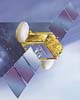
The successful launch Thursday of India's heaviest satellite from spaceport of Kourou in French Guyana may have boosted the country's space research efforts to yet another level, but it has also lifted the spirits of at least three Direct-To-Home televisions broadcasters, one of which has been waiting for years to launch its services in India. |
|
|

|
|
|
|
|
|
|
|
|
|
|
|
| The content herein, unless otherwise known to be public domain, are Copyright 1995-2006 - SpaceDaily.AFP and UPI Wire Stories are copyright Agence France-Presse and United Press International. ESA PortalReports are copyright European Space Agency. All NASA sourced material is public domain. Additionalcopyrights may apply in whole or part to other bona fide parties. Advertising does not imply endorsement,agreement or approval of any opinions, statements or information provided by SpaceDaily on any Web page published or hosted by SpaceDaily. Privacy Statement |