|
 |
 |
 |
 |
 |
 |
 |
 |

 |
Successful Testing Of Jules Verne Videometer
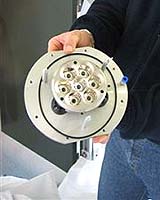
Paris - Mar 29, 2004 For the first time, the 'videometer' (VDM), a new technology device to ensure very precise automatic rendezvous operations between the 20.7 tonne Jules Verne Automated Transfer Vehicle and the ISS, has been successfully tested this month.
State of the art "For the first time, the ATV rendezvous sensors were used successfully in real conditions. And, within their operational domain, they worked exceptionally well," said ESA ATV engineer Stein E. Strandmoe, who supervised a critical 10-day test campaign.
Precision These built-in automatic capabilities of the ATV must be compatible with the demanding requirements of human spaceflight safety, necessary for the permanently crewed ISS.
Target patterns During the last 200 metres of the orbital final approach manoeuvre, the videometer must automatically recognize the retroreflectors target patterns and then calculate the distance and direction to the docking port. This precise tracking of the relative motion between the two spacecraft as they get closer � starting at a speed of up to 3.6 km/h � provides indispensable information to the on-board Guidance, Navigation and Control (GNC) system, which automatically pilots the bus-sized cylindrical ESA cargo ship towards the ISS.
Rendezvous testing Inside an exceptional building, 600 metres in length, a 120 000 kg mobile platform, able to ride on 550 metre long rails, enabled the simulation of a continuous approach between the two space vehicles from a range of several hundred metres to within almost docking distance. On the platform, a set of passive rendezvous targets (retroreflectors), identical to the ones to be installed on ISS, were facing the videometer which was mounted on an articulated robotic arm (with six degrees of freedom) representing the ATV motion. This seven metre high mobile arm was used to simulate the angular movements of the ATV to check if the videometer was still able to target the ISS retroreflectors and provide the information to the ATV control system necessary to adjust its trajectory accordingly.
First time success "The most surprising thing was that the sensors were almost undisturbed when we tried to fool them with other reflecting surfaces or other lights that could interfere with rendezvous targets in the ISS background," said Strandmoe. "It's amazing how the videometer, as a totally new development, proved to be such a robust system. I was quite surprised that it worked so well the first time it was tested!" Community Email This Article Comment On This Article Related Links ATV Home SpaceDaily Search SpaceDaily Subscribe To SpaceDaily Express Space Tourism, Space Transport and Space Exploration News
 Spicing Up Space Meals
 Los Angeles CA (SPX) Jan 04, 2006
Since its launch a year and half ago, Minimus.biz has quickly become the place to go for individual and travel size items. Last week, NASA came to Minimus.biz and purchased several different travel size condiments to send with the astronauts to the International Space Station. |
|
|

| The content herein, unless otherwise known to be public domain, are Copyright 1995-2006 - SpaceDaily.AFP and UPI Wire Stories are copyright Agence France-Presse and United Press International. ESA PortalReports are copyright European Space Agency. All NASA sourced material is public domain. Additionalcopyrights may apply in whole or part to other bona fide parties. Advertising does not imply endorsement,agreement or approval of any opinions, statements or information provided by SpaceDaily on any Web page published or hosted by SpaceDaily. Privacy Statement |